River Meng, Lucas Raber, Storm Monroe
The Portrayal of Emotion in The Song of Roland and Perceval
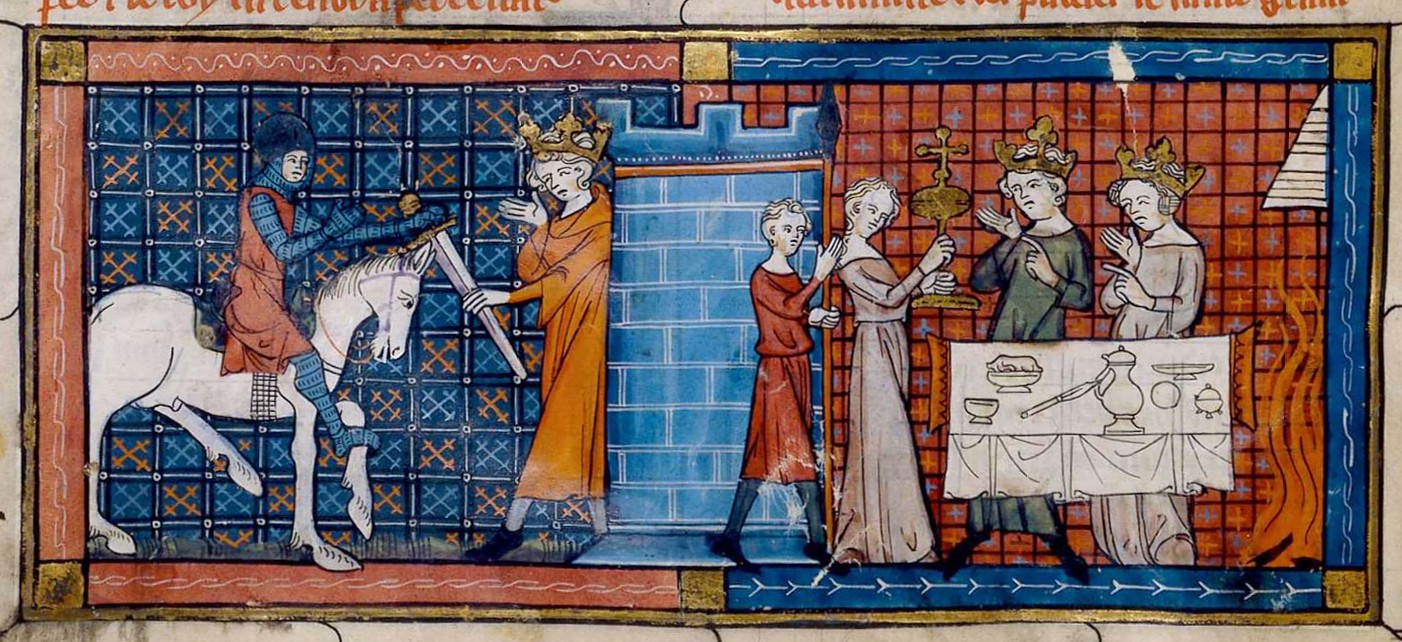
“He rode swiftly through the forest… until he saw… a maiden crying, weeping, and lamenting, as though she were a woman in great distress. ‘Wretched me!…. I was born in an evil hour! Cursed be the hour!” (Chrétien, 423).
While reading The Song of Roland and The Story of the Grail (Perceval), it was very evident that there was a vast difference between the ways in which the two authors express emotion. In his work The Making of the Middle Ages, Richard Southern discusses the significant shift from epic to romance towards the end of the 12th century, which was manifested in the repression of emotion in epic literature and the increasing emphasis on individualistic emotions in romance literature. In our analysis, we aim to uncover the ways in which authors’ expressions of emotions change between epic to romance literature in the 12th century. Through a combination of close reading and digital text analysis using Mathematica, we find evidence to support the notion that romance authors express emotion to a greater depth than epic authors.
Review of Previous Literature
The previous literature suggests that the emotion of grief is central to plot development in The Song of Roland. According to Angela Warner, grief appears more than thirty times throughout the text and exceeds any other emotional word (Warner, 211). Additionally, Lindsey Zachary supports this assessment by demonstrating that men cry twenty-four times and faint because of the intensity of their grief six times, while two characters go as far as to die from grief (Zachary, 29). While Warner and Zachary’s work suggests a prevalence of grief throughout The Song of Roland, they do not discuss the variation between the way that grief is expressed differently between epic and romance. In our research, we will analyze the differences more closely to determine the contrast between the two genres and the two works of The Song of Roland and The Story of the Grail (Perceval).
Contrary to the prevalence of a singular emotion, grief, in epic and The Song of Roland, previous literature emphasizes the importance of individuality and expression of a broader range of emotions in romance literature. Donald Wehrs elaborates on individuality and emotion in two separate pieces of scholarship. In one work, Wehrs discusses Perceval’s motivation, asserting that it is derived from the emotions of joy and excitement which are rooted in his own selfishness and lack of understanding of his own sin. Additionally, he claims that the individual emotions experienced by Perceval maintain great significance in the development of the plot within The Story of the Grail (Perceval) (Wehrs, 2014). In another work, Wehrs discusses the story of Yvain, which is another piece of romance literature written by the same author as Perceval. According to Wehrs, Yvain, similarly to Perceval, was motivated by self-love and a desire to correct past wrongdoings through his own individual acts (Wehrs, 2017). Through our research, we aim to gain a deeper understanding of how such individual emotions are expressed in romance literature and whether this type of emotion is also present in epic.
Overall, the current literature pertaining to both epic and romance suggests a contrast between the way that authors of the two genres express emotion. However, their research is not conducted with the goal of analyzing the two genres in comparison with each other, so there are gaps in the literature pertaining to the differences between epic and romance emotional expression. Ultimately, it is our goal to uncover such a contrast through a deep analysis of The Song of Roland and The Story of the Grail (Perceval), and we expect that the two stories and two genres as a whole will be vastly different in terms of the way that emotion is conveyed and the types of emotions that are more common in each. We also expect that emotion is more central to driving the plot of the story in romance literature and The Story of the Grail (Perceval) specifically.
Analysis Through Close Reading
A close reading and analysis of the specific passages expressing grief in both The Song of Roland and The Story of the Grail (Perceval) can provide further insights into how emotions are expressed differently in the two genres. In The Song of Roland, emotion is expressed in a direct and simple manner. There are rare descriptions of any actions or details of the characters that could imply their emotions throughout the text. In fact, the characters would simply state the type of emotion they are experiencing in their speech. In stanza 268, Aude, Roland’s fiancée, finds out from her brother, King Charles, that her lover forever shuts his eyes on the battlefield in Spain. Responding to this devastating news, Aude gives a short speech in which she expresses her grief directly before “d[ying] forthwith” at King Charles’ feet. In the speech, Aude states “To me, these words are meaningless./ God and His saints and angels now forfend/ I should live on when Roland’s life is spent!” (The Song of Roland, 37). Aude explicitly expresses her frustration and grief that Roland dies before her. However, there are no other expressions of emotions besides her words. Considering the fact Aude drops dead right after this speech due to excessive grief, her dying speech is far from a conventional emotional outburst of a dying person. In another passage in stanza 151, Roland experiences a similar emotional downturn and response as Aude after witnessing the death of his comrade Oliver. Seeing Oliver’s corpse “on the ground face down”, Roland is understandably heartbroken (The Song of Roland, 33). Yet again, his reaction reflects a reserved emotional outburst through his short speech. Roland mourns Oliver’s death by directly stating that “Now thou are dead I grieve to be alive”, without any other further actions or words implying sadness (The Song of Roland, 33). Considering the fact that Roland and Oliver have lived “long years and days… side by side”, Roland’s one line of mourning as the final farewell to his companion is rather underwhelming and, to an extent, inhumane (The Song of Roland, 33). Moreover, as we will show later in the digital text analysis section, the author of The Song of Roland fails to use a wide variety of words to express the characters’ emotions, which also greatly prevents him from exploring the characters’ emotions in depth.
In our romance literature text The Story of the Grail (Perceval), on the other hand, Chretien de Troyes pays a lot more attention to details that are able to not only imply the emotion that the characters are experiencing but also maximize the dramatic effects of events. In a passage on page 423, Chretien describes a weeping maiden that Perceval encounters while riding through the forest. Recently found out her lover is dead, the maiden is in a state of intense mourning when Perceval finds her. Not only is the maiden “crying, weeping, and lamenting,” but she also gives a paragraph-long speech cursing death for taking away her lover (Chrétien, 423). The maiden starts off her speech with three consecutive exclamation sentences, which vividly express her indignation at Death’s cruelty and her misery without her lover’s protection. Towards the end of the speech, after two interrogative sentences questioning why Death takes away the life of her lover instead of hers, the maiden reaches the peak of her sadness and dares Death to “take [her] soul and let it be a servant and companion to [her lover’s] he’ll deign to accept it”. By using a combination of a variety of actions, words, and syntax, Chretien is able to vividly depict the extreme grief that the maiden is experiencing after her lover’s death. In another passage from the Perceval story, Chretien describes the grief that the people from Blancheflor’s castle experience when they witness their new hero, Perceval, leaving them for more chivalric adventures. Using the literary device of simile, Chretien compares the procession of people to Ascension Day or Sunday, emphasizing the grandeur of the procession and indirectly reflecting the sadness that the people are feeling towards Perceval’s leave. After his description of the procession, Chretien continues to build on the people’s grief by giving them a speech, in which the people tell Perceval that “[they] should grieve when you wish to leave us so soon” and that “ [their] sadness should be overwhelming, and indeed it could be greater”(Chrétien, 417). Through the visualization of the setting and using words emphasizing the extent of the grief, Chretien is able to explore the grief that these people are experiencing in depth in this passage.
Comparing the expressions of grief in The Song of Roland and The Story of the Grail (Perceval), it is obvious that because the Perceval story utilizes a more diverse range of words, actions, and writing techniques than The Song of Roland, it is able to convey the grief that the characters are experiencing more accurately and comprehensively. Moreover, because of the diverse tools Chretien uses to convey emotions, he is able to differentiate the extent of grief that his characters are feeling. An example would be that the maiden is feeling a more intense level of grief due to her lover’s death than the people at Blancheflor’s castle are feeling due to their hero’s temporary leave. In The Song of Roland, on the other hand, because of the limited methods that the author uses in describing grief, the level of grief is superficial and hard to differentiate between passages.
Digital Text Analysis
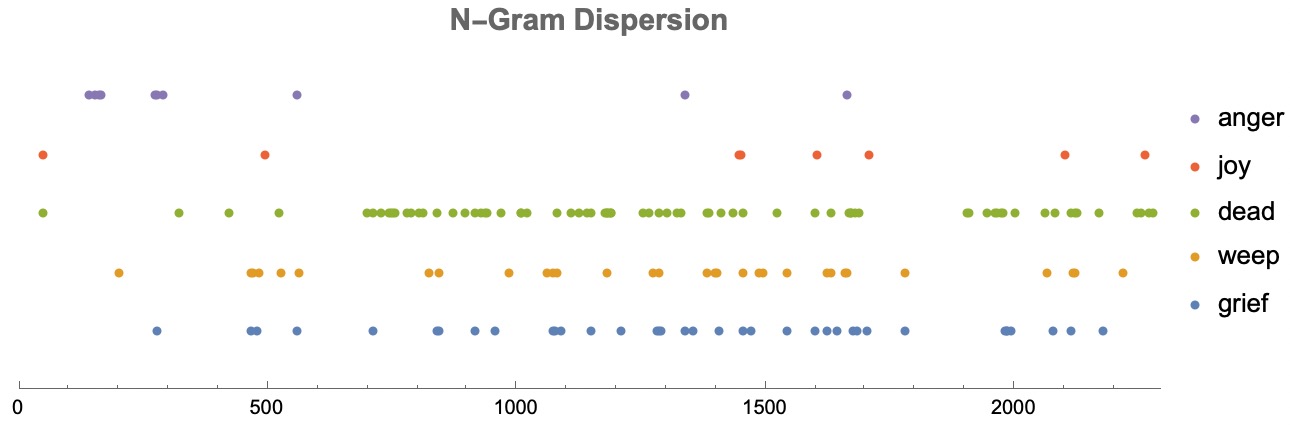
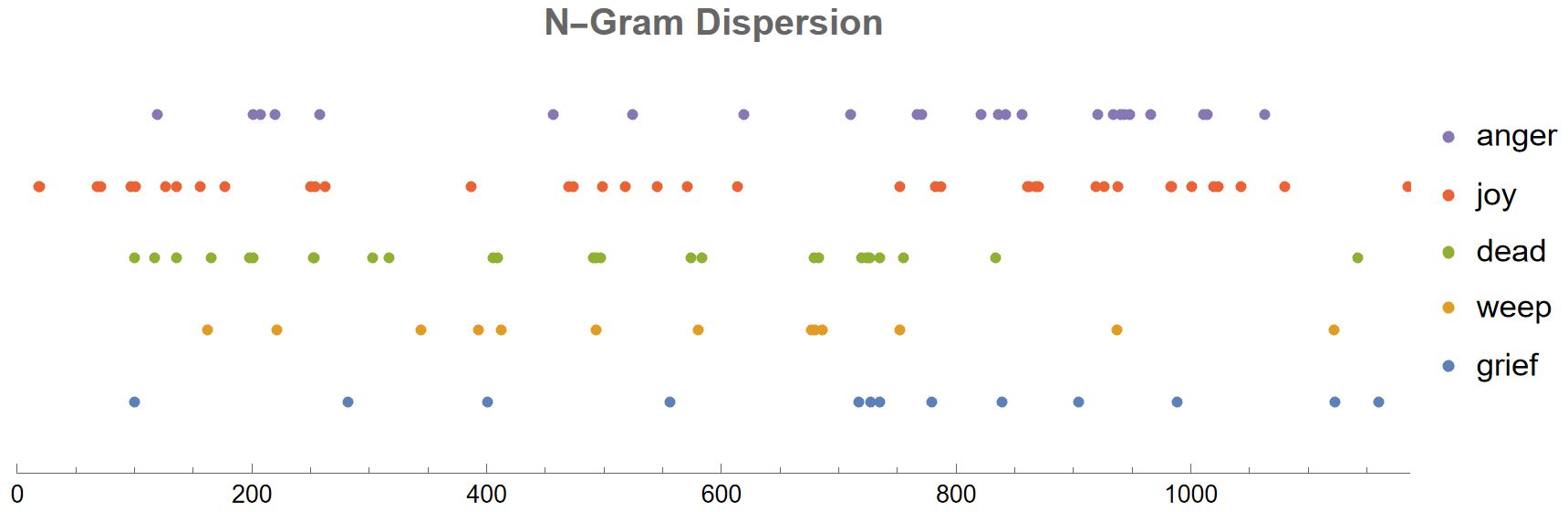
To take a deeper look into our texts, we used digital analysis methods to sift through what emotions were more prevalent and how often they were expressed. The first method we used was a dispersion plot to reveal how often single words representing an emotion were appearing throughout The Song of Roland and The Story of the Grail (Perceval). In doing so, we were searching to determine which emotions were focused on more and mentioned more than others in epic literature and then in romance literature. In looking at The Song of Roland, we found that three key words were vastly more numerous than in Perceval. The words “grief”, “weep”, and “dead” were mentioned very frequently. Transitioning to The Story of the Grail (Perceval), we found that the words “joy” and “anger” were referenced more throughout. By looking at this we noticed that death and grief did not match up with each other in The Song of Roland as much as one might expect. The lack of grief following death somewhat conveys a detached feeling to death, which is most prominently related to battle. Many lives were sacrificed to follow their duty to their leaders and in doing so, we see much of the honor and duty that is prevalent in epic literature. When looking at these words in context, it was also glaringly obvious that the words “grief” and “weep”, when referenced, were mentioned quickly and with little other explanation. They were made as statements to a character’s emotions or actions in a matter-of-fact way, rather than as being used to describe in detail the emotional state of a character. On the opposite hand, in The Story of the Grail (Perceval), death is mentioned much less and joy and anger are mentioned noticeably more. In the Arthurian Romances, the idea of the individual is much more important, and with this being the case, it also seems the author made this clear by using a character seeking out joy or reacting in anger throughout the story. The story is not focused on glorious and honorable death in combat, but on the growth of the individual, and this is represented in what emotions the author chooses to show in the characters as well as how they are expressed.
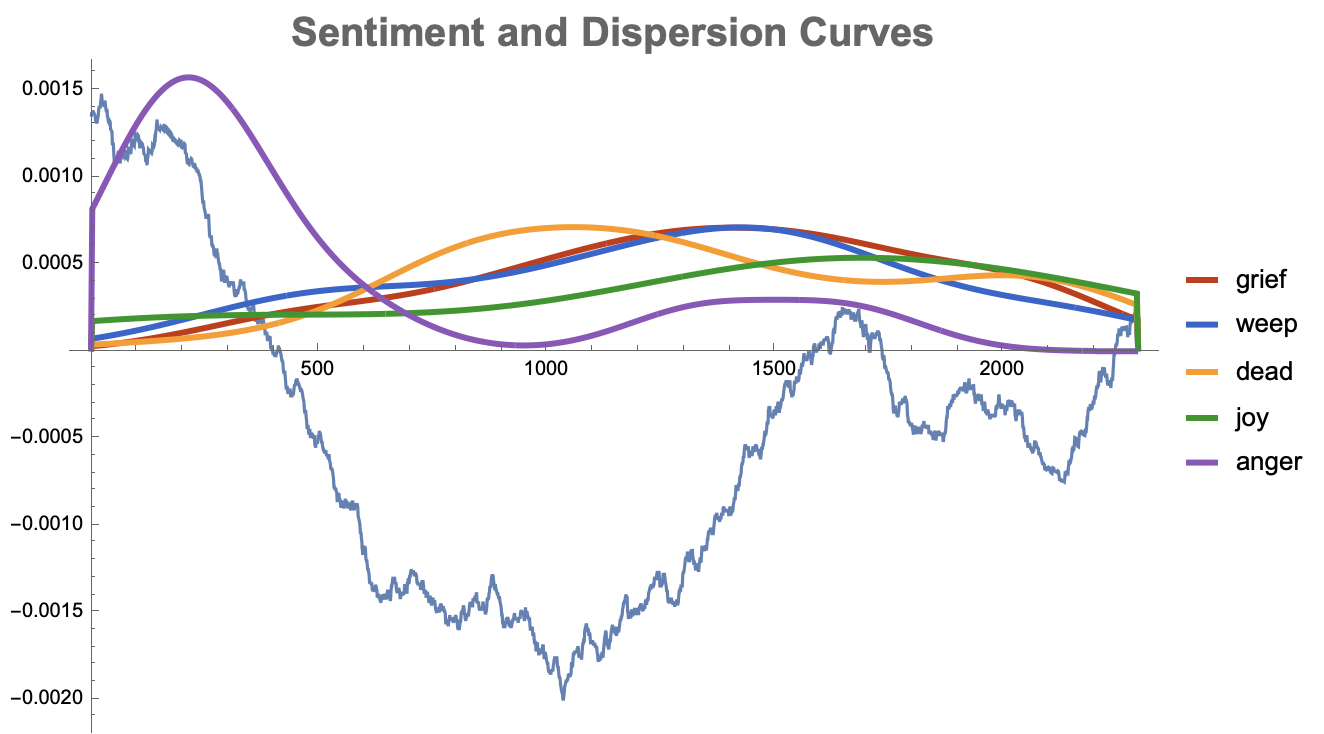
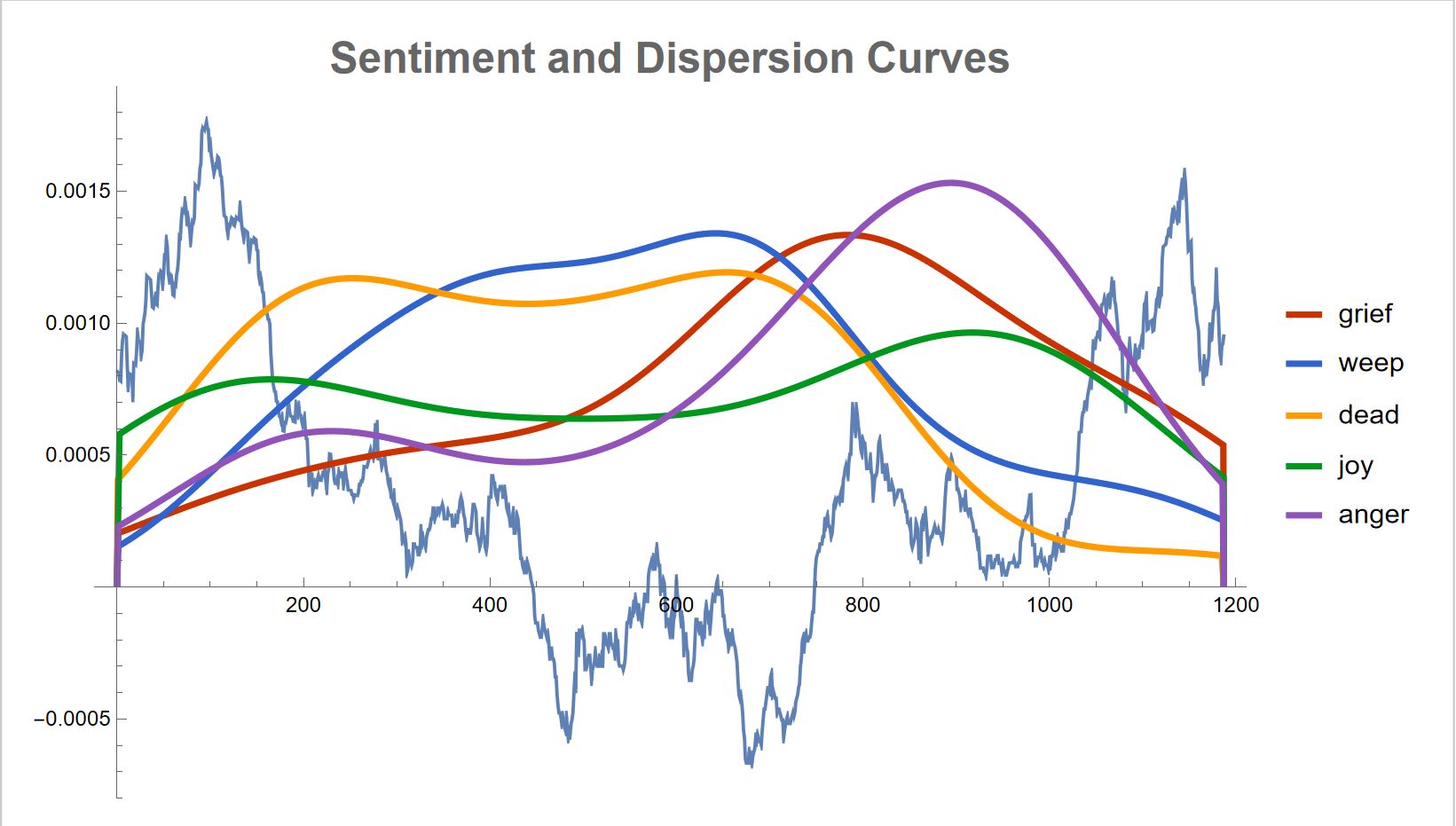
For our second digital text analysis method, we focused on sentiment curves. The main finding is very similar to our first digital analysis, which is that epic literature was written and expressed in a very solemn way, while Arthurian romance was more focused on a positive outcome that relied on the growth of the individual and the typical emotions that came with that progress. Looking at the sentiment curves, we noticed that in The Song of Roland, nearly the entire curve was negative, and a largely positive sentiment curve was only evident at the very beginning of the story. The sentiment only recovered slightly throughout the story and only broke into a positive curve once more later on before becoming negative again. We see the most negative point in the sentiment curve right around the part of the story when Roland dies. After, as Charles begins his path of revenge, the sentiment curve begins its gradual rise back in a positive direction. Whereas in Perceval, the sentiment curve was positive for the vast majority of the story, only curving into the negative twice almost directly in the middle of the story but quickly recovering. Again, both sentiment curves were heavily tied to the emotions that were most frequently expressed in our original digital analysis using dispersion plots. The Song of Roland, where grief and death are so prominent, has a negative sentiment curve. While on the other hand, The Story of the Grail (Perceval), in which Perceval grows from a young man into a matured knight, has an overly positive sentiment curve.
While each of these analyses may not particularly be complete argument-altering figures, they do help bring some level of statistical support to our findings in the actual literature. There is a greater focus on actual combat and death, and with it, a darker side of emotion that is more focused on grief when looking at epic literature. That emotion is also usually left at a basic statement rather than used to show a deeper and meaningful aspect of the character. When moving into Arthurian romance, there is a greater focus on joy. When looking at the story of Perceval and his journey from a young and naive boy, into a young man, joy would make sense in his growth. All of these emotions shown also reflect their respective sentiment curves. Rather than claiming our digital analysis as the basis of our argument, we believe it offers strong support behind our focus and argument by physically showing the comparisons of emotions mentioned. It also helps reveal the overall mood of each story which is revealing to what each style of author wanted to accomplish in how he expressed emotions throughout his work.
Final Thoughts
Overall, through both our close reading and our digital text analysis, we find evidence to suggest that emotions are explored more in-depth in romance literature, and more specifically in The Story of the Grail (Perceval), than in epic, or The Song of Roland. By gaining a deeper understanding of the ways in which the authors of these two genres expressed emotion differently, we can perhaps able to gain insight into the thoughts and feelings of society as a whole before and after the shift. Richard Southern suggests that new thoughts and feelings during the 12th century were not exclusive to religious life, but “pervaded secular society, or at least that part of secular society which has left any record of its thoughts and feelings” (Southern, 241). Our research supports Southern’s argument by showing that there is a shift in the expression of emotions in secular literature in the 12th century. Future research may be able to gain a greater insight into the change in emotional expression between these two genres of literature by compiling many or all of the available epic and romance works from the 12th century. We hope to see the findings of such a project in the future as more work is done pertaining to emotion in epic and romance.
Citations
Burgess, Glyn, ed. The Song of Roland. Penguin Classics. London, England; Penguin Books, 1990.
Chrétien de Troyes, William W. Kibler, Carleton W. Carroll. Arthurian Romances. Penguin Classics. London, England; Penguin Books, 1991.
Southern, R. W. The Making of the Middle Ages. London: Hutchinson’s University Library, 1953.
Warner, Angela. ‘“Doel” in situ: the contextual and corporeal landscape of grief in La Chanson de Roland,’ In Affective and Emotional Economies in Medieval and Early Modern Europe, Edited by Marculescu, Andreea and Morand-Métivier, Charles-Louis, 211-226. New York: Palgrave Macmillan, 2018.
Wehrs, Donald R. “Emotional Significance and Predation’s Uneasy Conscience in John of Salisbury and Chrétien’s ‘Perceval’” Literature and Theology 28, no. 3 (2014): 284–98.
Wehrs, Donald R.. “Narrative and affect in epic, romance and the novel.” In The Palgrave Handbook of Affect Studies and Textual Criticism, Edited by Wehrs, Donald R. and Blake, Thomas., 413-449. Cham: Palgrave Macmillan, 2017.Zachary, Lindsey. “When Men Cry: Male Demonstrations of Grief in ‘Beowulf’, ‘The Song of Roland’, and ‘Sir Orfeo.’” ProQuest Dissertations and Theses. M.A., University of Arkansas, 2011. ProQuest Dissertations & Theses Global (864888703).
