Paxton Williamson & Harsh Patel
Digital Medieval History
Examining the Role of Women across Epic and Romantic Literature
Women of the twelfth century were able to inherit and own property and land. In many cases, they were expected to fill in and participate in business and commerce for their husbands and fathers. Yongku Cha discusses these instances and describes a woman who takes on a more masculine role and completes manly tasks as a virago. Cha discusses the twelfth-century dichotomy of femina and virago women, the femina being sexual temptresses, and the virago being helpful constructive women. He finishes his discussion off by stating that women were viewed as lesser than men, but by filling the role of a virago, they can bridge this gap (Cha, 59-61). As the twelfth century was a shift from the epic to the romantic period, one might expect that some sort of shift in the viewpoint surrounding women occurred. Here lies a problem. Very few texts discuss the role of women in society and even fewer denote that any sort of change occurred during the twelfth century. With no real evidence of change, is there a way to claim that a shift did occur in the role of women? A solution to this issue may lie in the poems, stories, and myths of the time period. Literature often reflects the viewpoints of the author and therefore the viewpoints of the time period. By examining texts from the time period, historians today can step into the past and make inferences about society and its structures. Based on The Song of Roland and The Story of the Grail (Perceval) the role of women did not significantly change between the epic and romantic periods, as both genres of literature still view them as supporting characters for the lead males.
Analysis of Primary Sources and Situating It in Relevant Historiography
The Song of Roland is an 11th-century epic written by Turold that details the Battle of Roncevaux Pass between the Franks and the Moors. This poem contains many characteristics that define an epic from the period: courage, honor, betrayal, a battle of good and evil, and a lack of free will. The text’s initial main character is Roland, a Frankish military leader who with his best friend Oliver will do anything for his ruler and uncle Charlemagne. The initial conflict takes place when Ganelon, Roland’s stepfather, who is married to Charlemagne’s sister, is sent to discuss conversion and surrender with the Saracen king Marsille. In his meeting, Ganelon gives Marsille the key to beating Charlemagne: killing Roland. The epic proceeds with Roland defending Charlemagne’s rearguard and the planned attack of said rear guard. Pride proceedeth the fall, and Roland’s refusal to sound his horn for reinforcements before it is too late leads to his demise. The rest of the poem follows Charlemagne avenging Roland’s death and eventually defeating the Saracen king.
Very few female characters appear in The Song of Roland. The only two that ever appear are Aude, Oliver’s sister who is also Roland’s fiance, and Bramimonde, the Queen of the Saracens and Marsille’s wife. Aude serves as a means of motivation or a tool for scorning Roland’s pride. When Roland realizes hope is lost and says he shall finally blow the horn to signal for Charlemagne, Oliver scorns him for not doing so sooner. Oliver says “Again behold my sister Aude the bright, Between her arms never you think to lie” (Turold,117). In this excerpt, Oliver uses his sister to belittle Roland for not taking action sooner that would save their lives. The remark clearly resonates with Roland, as in the next line he asks his friend why he is so angry. After finding out about Roland’s death, rather than marrying Charlemagne’s son who she has been offered, Aude takes her own life to reunite herself with Roland. This final act is a sign of commitment and support to the one she loves. Just as Aude supports Roland, Bramimonde almost always appears by her husband’s side, often predicting and foreshadowing the downfall of the Saracens to their Christian enemies. After he has been defeated, Bramimonde returns with Charlemagne to France and converts to Christianity. Both women play a minor part in the story but reveal a good amount about the roles of honorable women based on their conduct and actions. They almost seem to play the role of property as well; Aude in the sense that she belongs solely to Roland and therefore must day with Roland and Bramimonde as a token or trophy for Charlemagne as the winner of the war.
Literature about twelfth-century dynamics supports this idea. RāGena C. DeAragon discusses this in her article “Power and Agency in Post-Conquest England: Elite Women and the Transformations of the Twelfth Century”. In the article, DeAragon discusses the role of women in the twelfth century. Drawing on texts from Jo Ann McNamara and Suzanne Wemple, DeAragon analyzes their claim that women had very little power during the twelfth century. DeAragon’s main critique is that Jo Ann McNamara and Suzanne Wemple fail to define what they mean by power. Women of the twelfth century could own land. This ownership mostly occurred through inheriting the land from their spouse post-mortem. This in some sense conveyed power, but Dearagon acknowledges that most of the time when women of the middle ages held power it was when their spouses held power. Women of the middle ages often played a supporting role for their husbands and families (DeAragon, 19-22). Cha also discusses the idea of women holding power. Cha explains that women would attend business meetings with their husbands, or even by themselves if their husband was not available. Women would support the family in any way they could. In some instances, fathers used their daughters as a means of currency, marrying them off in exchange for status or to strengthen an alliance. In all cases, they played a supportive role to the head of the patriarch, whether that was their father or their husband (Cha,58-61).
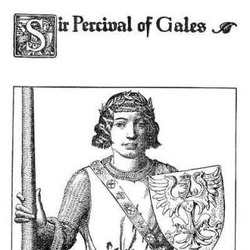
The romantic poem, The Story of the Grail (Perceval), provides a foothold into the world of Romance. Perceval was one of the infamous five Arthurian romances written by Chrétien de Troyes in the late twelfth century. The poem captures the story of Perceval, a young innocent boy who becomes a knight and pursues many quests on his journey; his journey encapsulates many elements of a romantic narrative: romance, journeying, emotion, beauty, free will, family, and religion. Through the actions and adventures of Perceval, there is an emphasis on spontaneity, individuality, and movement. Arguably the most persistent theme in The Story of the Grail is journeying, both in the spiritual and physical world. Throughout his journey, Perceval is constantly encountering new people and traveling to new lands. Perceval’s oath “that he would not spend two nights in the same lodgings as long as he lived” is a testament to his dedication to his quest (Troyes 439).
The topic of women is extensively mentioned within The Story of the Grail. Throughout the adventures of Perceval, Chrétien de Troyes fixates on the interactions between Perceval and the women he comes across. Women mentioned are generally acknowledged by name and provided a backstory; they also play a substantial role to help build up the chivalrous identity of Perceval. The wealth of female character presence helps drive the plot of Perceval. While the role of women did not function in a stand-alone manner, it filled an essential role in helping build up the masculine identity of men. Knighthood, a rank of a knight, was constructed to follow the code of chivalry. In his journey as a knight, Perceval came across Blanchefleur, a queen under siege by Clamadeus. Perceval states he’ll “bring peace throughout [her] lands” (Troyes 407). He proceeds to defeat the enemy, Clamadeus and liberates Lady Blanchefleur and her lands of torment caused by Clamedeus. In this encounter, the queen Blanchefleur is situated as a vulnerable and helpless woman who needs a knight to come to her aid and save her. In Men and Women as Represented in Medieval Literature and Society, Anita Kay O’Pry-Reynolds echoes a similar sentiment toward the involvement of women in romantic literature. From O’Pry-Reynold’s examination of literature from the Middle ages, she finds that women’s roles in literature and society were limited to enhancing their male counterparts. As O’Pry-Reynolds states: “There had to be someone to recognize the brave and heroic deeds of the men, and there had to be someone to mourn the dead, the men would not be wailing and grieving” (O’Pry-Reynolds 39). After captivating the heart of Lady Blanchefleur, Perceval decides to abandon Blanchefleur and her people to continue his journey. He remains oblivious to the pain and grief he causes the Lady Blanchefleur and her kingdom from his departure. The dynamic between Perceval and Lady Blanchefleur is an instance that highlights how women were necessary pawns to elevate the chivalric status of men.
As mentioned prior, journeying is a major theme throughout The Story of the Grail. The journeying that Perceval undergoes transcends the physical world. In a particular journey he embarks on, he becomes obsessed with “three drops of blood, which spread upon the white snow-like natural color” (Troyes 432). As he goes on this inward journey, he becomes lost in contemplation as the “blood mingled with the snow resembled the blush of his lady’s face” (Troyes 432). In this scene, Perceval is found in a trance state as he looks introspectively and sees his beloved Blanchefleur. This mentioning of Lady Blanchefleur gives an interesting insight into the distinct role of women. It shows that women couldn’t hold a main character role; instead, they are included in ways to help develop the plot and add a romance element to the narrative. This idea aligns with the observation made by author Sheila Fisher in The Cambridge Companion to Medieval Romance. In her chapter “Women and Men in late medieval English Romance”, Fisher emphasizes “the women’s potential to be hominis confusio”: a confusion to men (Fisher 152). Fisher unpacks why women do not hold major roles in literature and comes to the conclusion that it is because they confuse men. Women are mainly mentioned in chivalric romances to help define masculine chivalric identities. The greatest achievements of women in the middle ages were largely marginalized in order to solve the problem of “women” and the confusion they can potentially create. In Perceval, Lady Blanchefleur is minimized to serve simply as a romantic love interest for Perceval. Her character would not exist if it did not mention or reveal the character traits of Perceval or another male character. This use of women is consistent across all the female characters in The Story of the Grail. In the opening pages of the romance, Perceval leaves his mother against her wishes and she dies from grief. His abandonment and pursuit of becoming a knight bring extreme depression because her late husband and other sons died serving as knights. Again, in this instance, Perceval’s mother serves a temporary role and is quickly discarded; the portrayal of these women is diminished as subordinates to supplement the male identities associated with knighthood.
At first glance, the portrayal of women across epic and romantic time periods may seem to have shifted and allowed for the development of aristocratic women as they are mentioned in a greater depth. Following a deeper examination of women from both eras, it is evident through their portrayals in epic and romantic literature they were perceived in similar ways. In The Song of Roland, women were largely excluded because they did little to contribute to the overall identity of the text. Epics are characterized by a group serving a purpose greater than themselves, a lack of free will, religion, courage, honor, and the timeless battle of good vs evil. Self-identity plays a minor role, as most if not all epic characters serve a person or purpose greater than themselves. The infrequent mention of women is appropriate for the epic text because of the stylistic nature of epic literature. Epic literature does not focus on the details nor does it introduce minor characters. The lack of emphasis on individuality makes it appear as if women are removed completely from the text. This does not mean that women did not play a supporting role. Aude still acts as a support for Roland as she is a motivator for him in the text. She also does the right and honorable thing after his defeat by choosing to join him in death rather than remarry, again supporting him. Bramimonde also plays the supporting role by sitting by her husband’s side and supporting him. After defeat, she continues to play the role of a supporter by going with Charlemagne as a “prize” and converting to Christianity. While The Story of the Grail included many female protagonists, they served a similar role to female characters in the Song of Roland: enhancing the male character identities. The main difference between the packaging of women in these texts is due to the discrepancy between epic and romantic literature. Romantic literature provides greater emphasis on the individual and the minute details of an individual. It provides depth and backstory to all characters mentioned. This mentioning of female characters in romantic literature can be mistaken as an expansion of the role of women from epic to romance time periods. When scrutinizing the roles played thoroughly we can identify that women hold supporting roles, similar to epics, and are used to build up the identities of male protagonists. In the case of Perceval, the women mentioned are used to recognize the heroic deeds and achievements of Perceval. It becomes clear that the broad role of women remains relatively unchanged across epic and romantic literature.
Computational Analysis
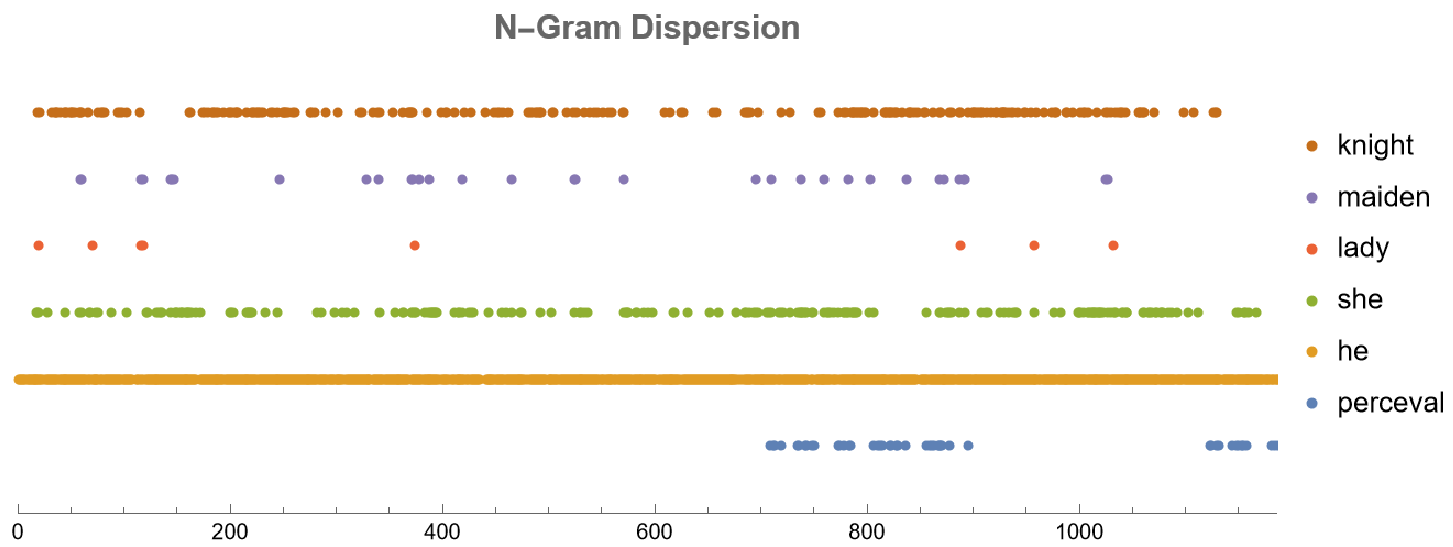
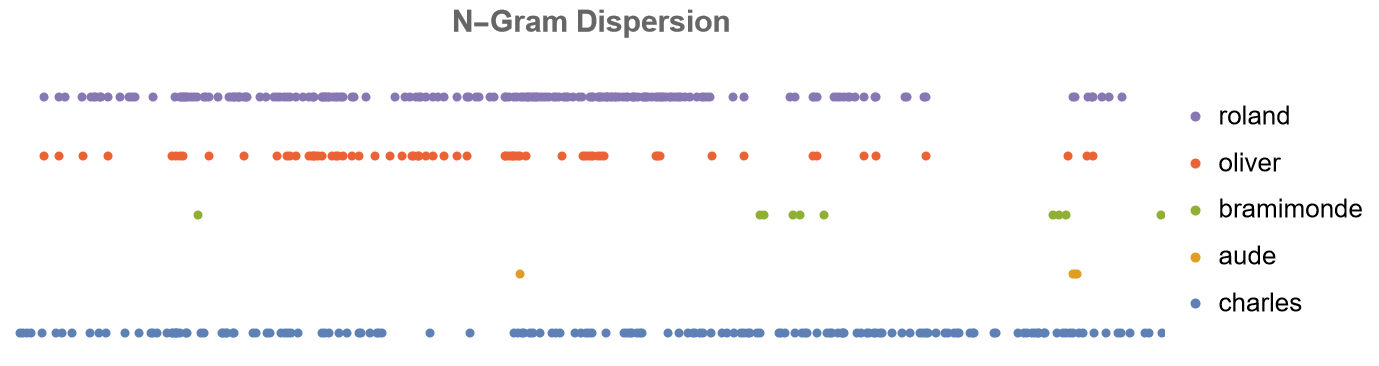
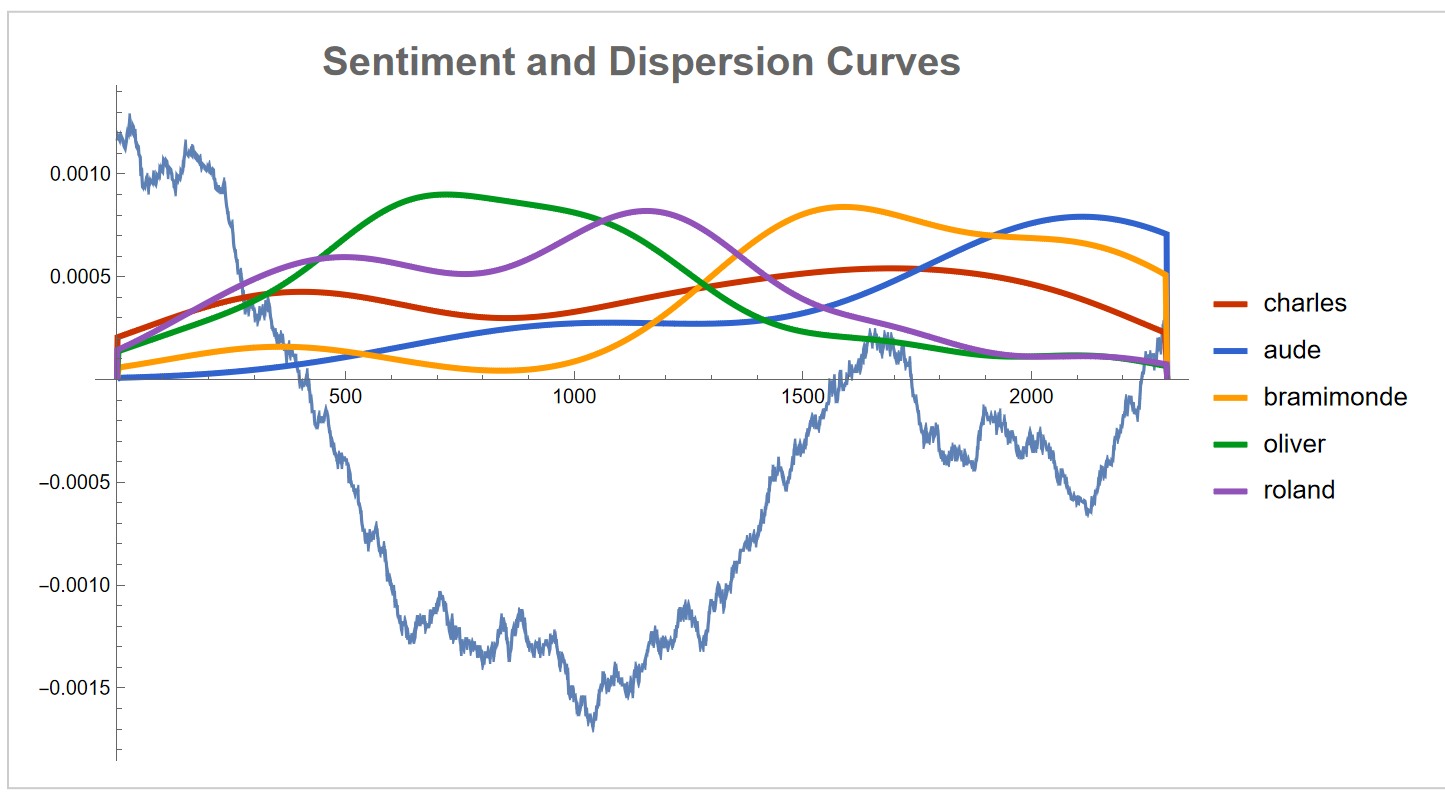
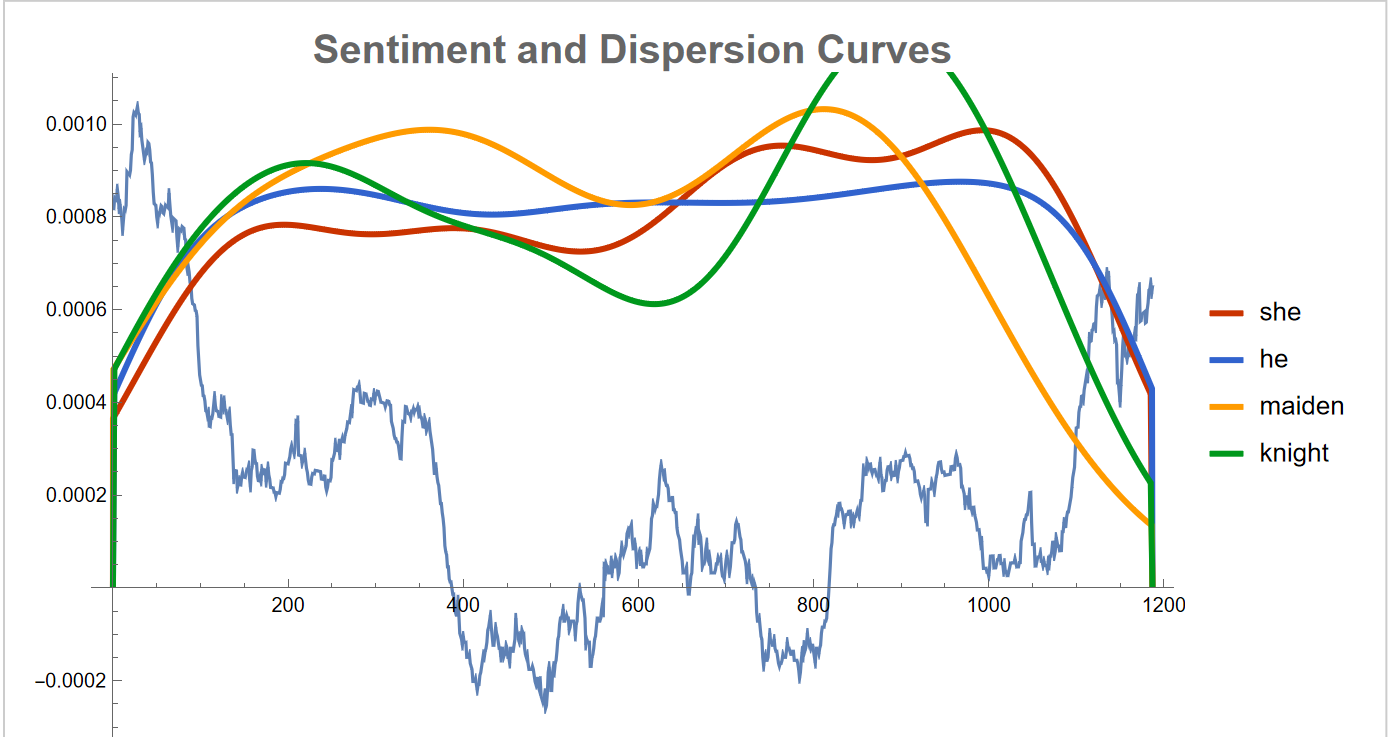
Using sentiment and dispersion curves allows for more insight into when characters or words are being used in relation to the overall sentiment of the story. When looking at the sentiment and dispersion curve for Roland, it appears that not much of a relationship exists between the male characters and the female characters. The graph does show that the two female characters are more likely to be mentioned when the story arch is returning to one that is more positive and nearer the end of the text. This makes sense, as the two women fill their role as the supporters of their men at the end of the battle, with Aude taking her own life to honor her husband, and Bramimonde returning to France as a trophy of war with Charlemagne. The sentiment and dispersion graph for Perceval reveals something interesting. There appears to be a slight relationship between the word maiden and knight. As the word maiden becomes more likely to appear, the word knight becomes more likely to appear. This would make sense as the female characters within the myth are mainly used to build up Perceval’s masculinity and chivalrous nature. It is also interesting that the knight and maiden also drop off at the same time, as it would make it appear that the role of the knight diminishes without the maiden. The N-gram dispersions also look at when a word appears throughout the book. The Roland graph again shows that the two female characters only appear at the end of the text, as that is where they serve their purpose of supporting their beloved, or serving as a trophy of war. The Perceval N-graph dispersion shows a relationship between Perceval and maiden, where Perceval appears most frequently around the times maiden is most frequently used. This again suggests that Perceval’s masculinity and chivalry are supported and built up by the female characters he encounters. Without these women, he would lose some of his sense of purpose.
Conclusion
Through our exploration of The Song of Roland and The Story of the Grail, we were able to examine how the role of women shifted across the epic and romantic periods. From our close reading of the texts, we find evidence that suggests the roles of women remained the same; the style of epic versus romantic literature can explain the difference in the quantity and depth of female characters across eras. Any mentioning of women is generally accompanied by a male counterpart and female roles largely function to develop or support him. Future research can be conducted to examine whether the role of women remains stagnant for a different set of texts across these two genres. Few scholars have examined the role of women in romantic literature. Examining a larger set of epic and romantic literature can advance our understanding of women in Epic and Romantic literature. The infancy of this field allows for substantial contributions to be made and finding newfound insight to help develop the foundation of this field.
Citations
Cha, Yongku. “A Clerical View of Gender in Twelfth-Century Flanders: The Voice of Lambert of Ardres.” Parergon 37, no. 1 (2020): 55–77.
DeAragon, RāGena C. “Power and Agency in Post-Conquest England: Elite Women and the Transformations of the Twelfth Century.” In Medieval Elite Women and the Exercise of Power, 1100–1400, edited by Heather J. Tanner, 19–43. Cham: Springer International Publishing, 2019.
Fisher, Sheila. “Women and Men in Late Medieval English Romance.” In The Cambridge Companion to Medieval Romance, edited by Roberta L. Krueger, 150–64. Cambridge Companions to Literature. Cambridge: Cambridge University Press, 2000.
O’Pry-Reynolds, Anita Kay. “Men and Women as Represented in Medieval Literature and Society.” Saber & Scroll Historical Journal 2, no. 2 (2013): 28488.
Troyes, Chretien. Arthurian Romances. Penguin UK, 1991.
Turold. The Song of Roland. Translated by Dorothy L. Sayers. Penguin Books, 1957.
