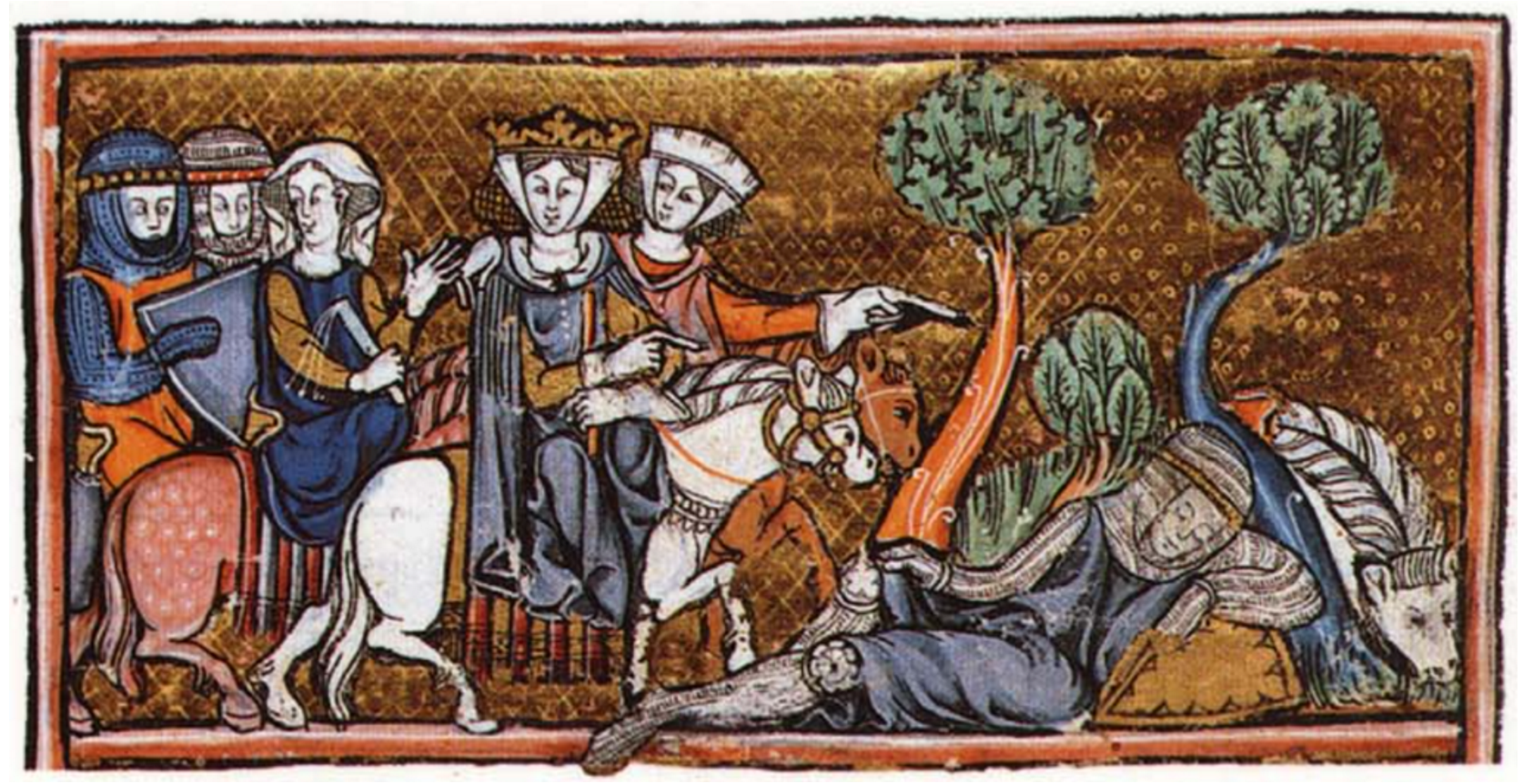
The Role of Masculinity in Epic, Saga, and Romance
Thomas Warren and Luca Voichick | 5/10/2022 | HIS 207
Lords of Charlemagne’s court sounding off great bugles of war, Arthurian knights genuflecting at the feet of fair maidens, and marauding Norse chieftains waxing poetic over slain foes. Masculine, rugged men are at the forefront of the narratives in Turold’s the Song of Roland, Chretien’s Knight of the Cart, and Egil’s Saga. However, how these men behave and the ways their respective masculinities are depicted are vastly different (where masculinity is defined as the ideals and roles a male hero is expected to fit within their particular genre). In the romance genre, emotion, courtly love, and knightly honor are the most critical components of a masculine man such as Lancelot. In the epic, the reckless and impulsive Roland is the archetype of manliness. And in the saga, Egil, both a violent and impetuous scoundrel yet also a wise and successful poet, is the male ideal. In this work, we seek to examine masculinity across these three texts and identify how it functions in each genre. We then aim to put these observations in dialogue with one another and the historiography. Particularly in our work with Chretien’s Knight of the Cart, we seek to prove that Lancelot’s failure to meet masculine ideals makes the work both a cautionary tale and a satire on the folly of overly extreme love.
Epic: Song of Roland
By 12th-century epic standards, masculine figures were those who maintained positions of strength and power; fulfilling societal obligations was paramount to maintaining clearly defined social classes. A lord‘s fulfillment of masculine ideals was achieved not only by control over his surroundings but by excelling at one‘s social obligations to his king and vassals, or in other words, by closely following the feudal chain of command. In addition to defense and conquest, a lord must help bridge social connections within a king‘s expanded network. Narratively, in the Song of Roland, King Charlemagne interacts briefly with numerous disciples, whereas Roland has more substantial relationships with his circle of trusted knights and lieges and more drawn-out conflicts with his enemies.
We will now show how Roland fulfilled his duties and also is a more integral character in the story with a wide-view textual analysis. After tallying all interactions within the novel, we plotted these with graphical analysis. Next to this interaction graph is the betweenness centrality measure, which indicates the number of shortest paths that go through the character vertex when connecting all character interactions. King Charles joins the most number of shortest paths between all character interactions, indicating that many characters‘ connections within the novel appear only with him.
Masculinity in Epic: Roland – Graphical Analysis


Having a king as the character with the most significant betweenness centrality ranking follows intuition as the king is expected to have connections with different groups of allies and enemies across empires. Roland, however, has a separate masculine responsibility as a lord, as he must interact more closely with characters with whom he interacts throughout the novel to bridge these strong connections with the king. In the following analysis, we test whether Roland holds strong interactions to determine whether Roland is fulfilling a lord‘s masculine ideals.
We classify all strong interactions as those that occur at least three times throughout the story and remove all nodes that have no remaining connections to the largest web of character interactions. This filtering is intended to focus on only strong character interactions throughout the story instead of weak relationships that may occur just in passing. The following graph shows all remaining characters (indicated by the vertexes) and character interactions (characterized by the edges) that remain after this filtering. The node‘s rank is based on the betweenness centrality of the particular character, or the number of shortest paths that must traverse through this node to reach other nodes, which tests the strength of that specific character‘s importance in connecting the web of characters with strong interactions within the story. As can be seen, both King Charlemagne (depicted in the largest node on the left) and Roland (displayed in the largest node in the center) appear to have the most substantial number of interactions. The betweenness centrality measure is shown next; however, further analysis is necessary to determine and interpret how this graphical analysis can compare the importance of King Charlemagne and Roland in the novel.

In the following charts, we use the same style of graphical analysis to compare and interpret the breadth of character interactions within the text. We use the same filtered set of edges but remove Roland and all Roland‘s edges from the graph (left) and then remove King Charles‘s connections and all of his connections from the diagram (right). The betweenness centrality measures for these analyses indicate that Roland has more of a central role in connecting strong interactions. As expected, his more extensive array of strong interactions indicates that he fulfills lordly obligations by interacting more with strong characters. These interactions are threefold: enemy interactions (like with Marsile & Malprimis), allyship (like with Naimes, Roland‘s advisor), or other strong social connections.
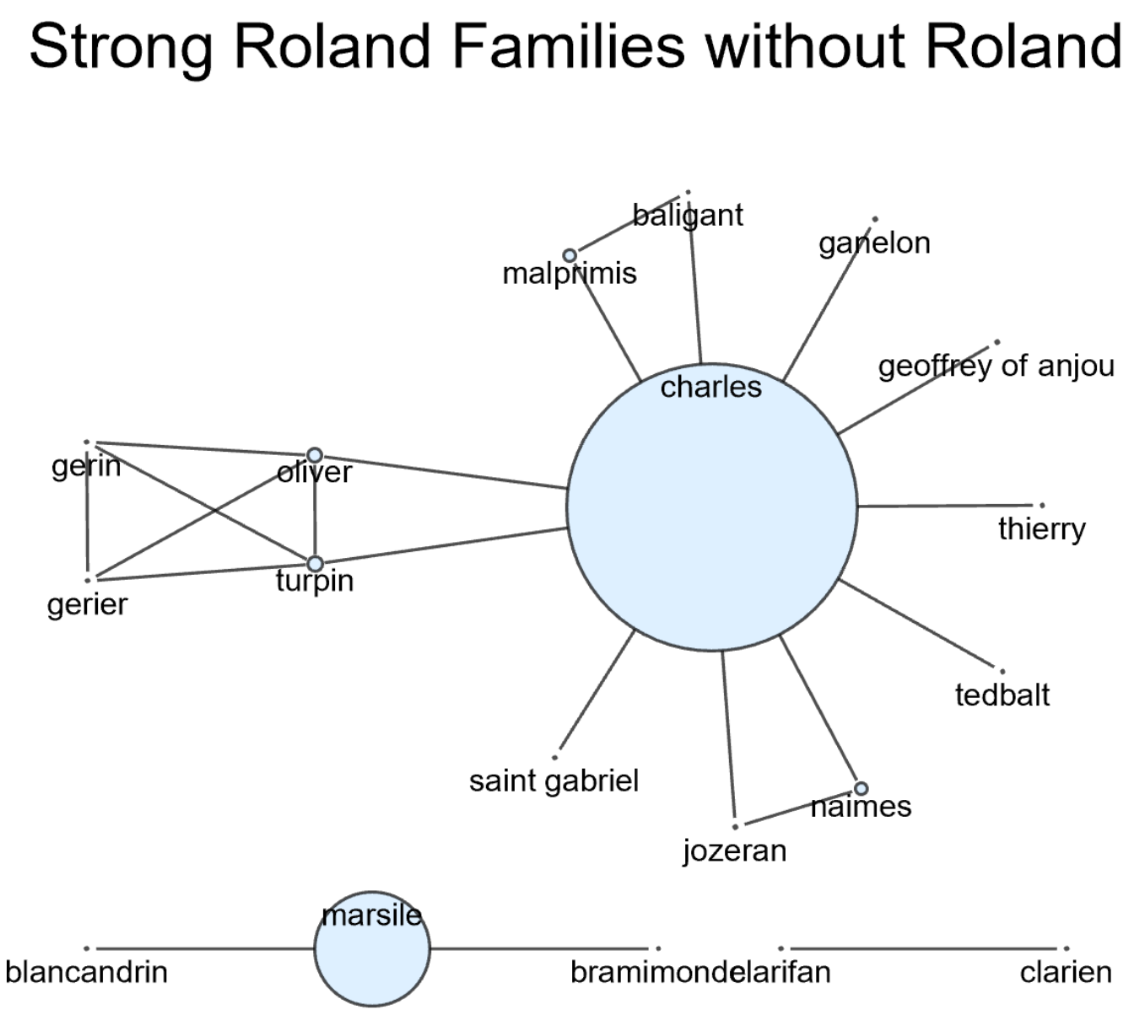

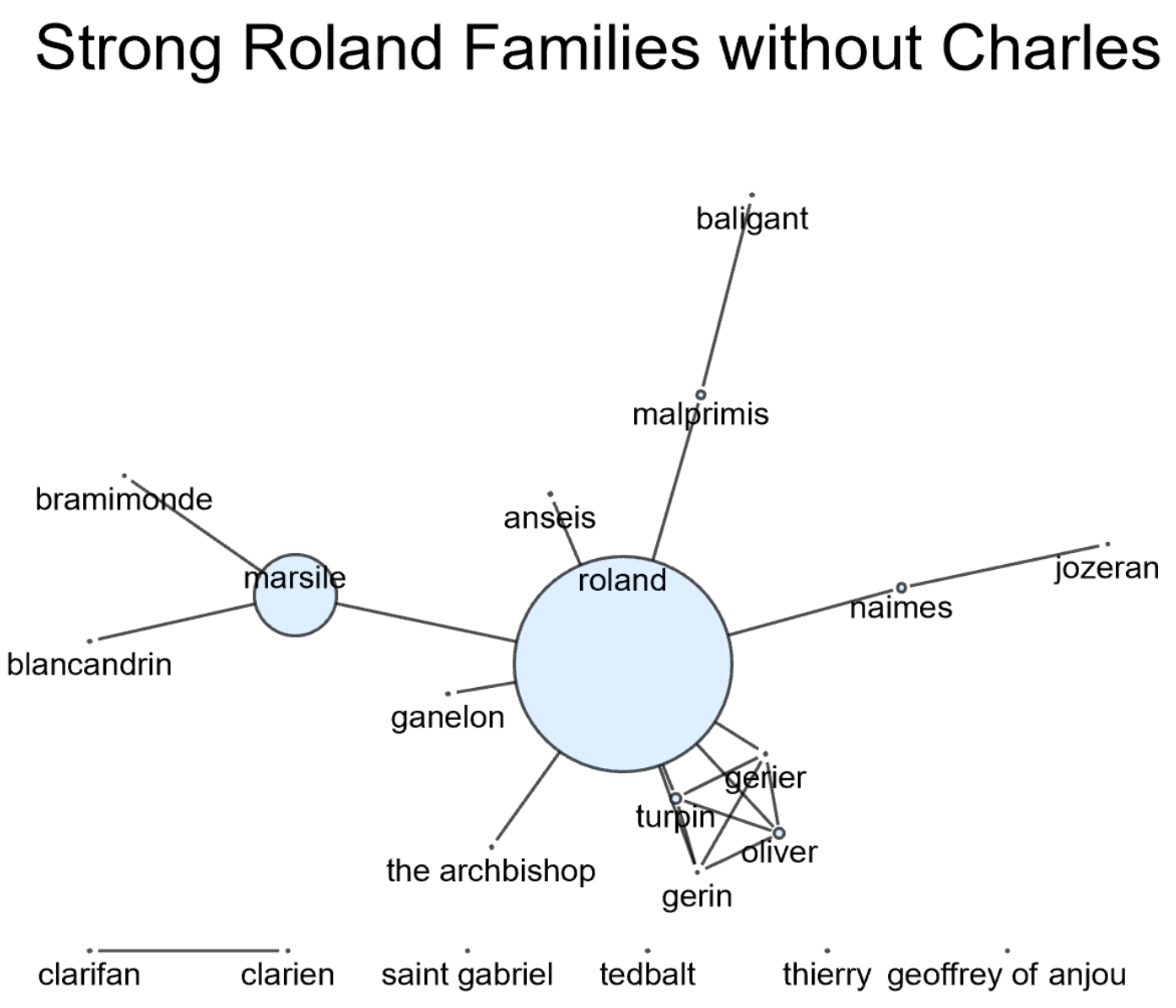

Roland‘s lordly responsibility is to bring his knowledge and power to the king‘s service, and his service lies not only with the king but also with his vassals and peers. While the king serves as an essential character for connecting all characters in the novel, Roland is more important for connecting characters with strong interactions, which can be considered masculine by epic standards.
Masculinity in Epic: Roland – Textual Analysis
Because 12th-century epics hold a distinct form of masculinity for those who serve directly to the king, we focus on Roland in this piece to further explore the role of masculinity in epic. The analysis here will prove valuable when analyzing the weaker forms of masculinity shown in Lancelot. The defining traits of Roland’s masculinity are his loyalty, pride, impulsiveness, and prowess in battle. Roland’s loyalty reflects the expected or perhaps idealized dynamic between a king and his subject; although Roland is subservient to Charlemagne, many men revere him because he chooses to submit himself entirely to Charlemagne’s service.1 However, Roland sets himself apart as bold and quick to action when he directly contradicts the king and even talks over him.2 Roland is a paradoxical figure; he is described as a vital piece of the king’s body: his right arm, but he is unafraid to challenge his king directly. Given the genre of epic, the subservient nature of Roland’s responsibilities as a lord and his audacity to question his authority work to generate a masculine persona.
Another aspect of Roland’s masculinity is his strength and pride on the battlefield. He is depicted as being quite skillful at slaughtering foes with excellent swordsmanship. He cleaves through a man’s skull and body all the way down to his horse.3 Yet, perhaps his masculine ego overwhelms his sound judgment when he refuses to call for reinforcement when his position is being overrun:
Comrade Roland, sound your horn; Charles will hear it as he crosses the passes, and I warrant you the French will turn back.” “May it not please God,” replies Roland, “that it should be said by any living man that I ever sounded my horn on account of the heathen. Never shall my kinsfolk be reproached on this account. When I am in the thick of the battle, I shall strike a thousand and seven hundred blows, and you will see the steel of Durendal stained with blood. The French are strong, and they will strike valiantly; the men of Spain will have no protection from death.”4
Within this passage, Oliver beseeches Roland to sound the horn for aid as the Saracens mount their ambush of the rear guard. Roland refuses because it is below himself as a Christian to sound a horn on account of heathens. He also does not want to bring dishonor to his family. Finally, Roland is incredibly self-confident, perhaps to the point of hubris, and this trust in himself and his prowess in battle also informs his decision not to sound the horn. We all know what occurs next, but it is at this moment we see what goals and fears drive Roland’s masculine persona.
Saga: Egil’s Saga
In Egil‘s Saga, Egil is even more paradoxical than Roland. Egil‘s propensity for violence and mischief is much greater than even Roland‘s. The seven-year-old Egil brutally murders another young boy who had beaten him at a children‘s sports contest.5 Later, as an adult, he gouges the eye out of a man who did not offer him and his men as good of a drink as other guests.6 There are numerous examples of Egil reacting to a situation with violence and temper much more significant than expected for a man in his position. And it is not just with people less powerful than himself that Egil is disagreeable. Egil has a long-standing feud with the King of Norway in which he kills many important liegemen of the king and steals numerous goods from them.7 On the other hand, Egil is manly and fits the saga ideal of a man due to his obstinacy, strength, and bravery in battle. Similarly, one of the calling cards of great men in sagas is their physical appearance. At one point, a summary of Egil‘s adult appearance is given:
“Egil was large-featured, broad of the forehead, with prominent eyebrows, a nose not long but very thick, lips wide and long, chin exceeding broad, as was all about the jaws; thick-necked was he, and big-shouldered beyond other men, hard-featured, and grim when angry. He was well-made, more than commonly tall, had hair wolf-gray and thick, but became early bald. He was black-eyed and brown-skinned.”8
According to Wills‘ “Physiology and Behavior in the Sagas,” men with high testosterone features like Egil are more likely to be involved in conflicts and more aggressive domineering behavior in both real life and saga narratives. Egil essentially fits the bill for how a saga protagonist should look and act. However, there is a surprising wrinkle to his character as well. One would not expect so ruthless of a killer to have such a vivid inner emotional life and such a propensity for literature. A section that exposes the “softer side” of Egil in both aspects is chapter 81.9 Egil‘s son Bodvar tragically drowns within this passage, and Egil plunges into a dark and borderline suicidal depression. This outpouring of grief seems at odds with what we might expect from strong and stoic Egil. Nevertheless, Egil‘s strong emotions spur him to concoct a long-form poem to commemorate his son, and simultaneously it lifts him out of his great sadness. That a fearsome warrior who uses his might to take from others is also so adept at expressing emotion through verse and meter is a peculiar and uniquely nordic character trait.
Finally, there is the aspect of wealth within sagas and Egil as a wealthy man. Wealth is almost a Finally, there is the aspect of wealth within sagas and Egil as a wealthy man. Wealth is almost a benchmark of masculinity in the world described by the saga. Strong, powerful, and opportunistic men are the ones who earn wealth and fame. Egil‘s violent deeds and wanton raiding are one component of what makes him masculine, but his material rewards for this behavior are an equally important part. Gold, silver, furs, timber, amber, and longships are exchanged between men of high stature to secure alliances and friendship.10 These goods are then bestowed upon liegemen, wives, or enjoyed by the men themselves. Thus riches indicate high social status and powerful relationships that come with such prestige.
Masculinity in Saga: Egil’s Saga – Concordance Analysis
When a heroic and manly character passes away, he is described as a man of “wealth and renown.”11 We examined how wealth, money, and gold are used in the concordances (see below). They almost always go hand in hand with how a man earns or uses them. In one specific concordance, a man is described as noble despite always having trouble with money. Interestingly, before his virtues are mentioned, he often was short of funds, and the epithet “open-handed” is used. In the world of the saga, a masculine man is expected to have wealth, and thus it is an anomaly worthy of note for a noble and respected masculine man not to be rich. Concordances allowed us to hone in on the specific ways in which wealth represents masculinity and status within the saga genre.

Romance: Lancelot
In Chretien‘s Knight of the Cart, Lancelot is the main character and the example of masculinity we have focused on to describe the depiction of manliness within the narrative and, more broadly, the genre of Romance as a whole. The Arthurian romances are highly concerned with the ideas of chivalry, courtly love, and knightly honor. Thus, these codes of conduct and social mores inform Lancelot‘s masculinity and lack thereof when he chooses to pursue love. In the Knight of the Cart, Lancelot is concerned with rescuing Queen Guinevere, and attempting this task is what constitutes and conflicts with his masculinity. In the beginning, we get a very sparing portrait of Lancelot as a masculine hero who fits the ideals of a knight. He first travels through a foreign land on a steed befitting a man of high birth with his sword and armor. These worldly possessions are symbols of his elevated status, success, and the wealth inherent to his position as a knight. Lancelot then rides his horse to death, which is an impressive feat. To ride that fast and hard for so long shows a high level of physical endurance. And for him to casually discard such a valuable asset is reminiscent of the impulsive and hyper-masculine traits that have made up characters like Roland or Egil. Lancelot is clearly set up to be a masculine figure, and in many respects, he is. His prowess and physical attributes are undeniably the ideals of what a knight should be, and his skill at engaging in a quest is thus second to none. However, his loyalty to his king is less than stellar as early in the narrative; we realize his quest to find Queen Guinevere is not motivated by his loyalty but rather by his carnal desires. Following or seeking love is considered masculine within the romance genre, but a paradox is reached within Chretien‘s work when this love is forbidden. What is even more emasculating about this specific love is the lengths that Lancelot will go to to achieve it. Lancelot stoops to great depths beyond what is expected of a knight.
Perhaps the most significant passage in the whole story of the Knight of the Cart is the scene that gives the work its namesake. Lancelot has spurred another horse to death in his frantic, almost rabid pursuit of Guinevere and her captor. With no other option, he is propositioned by a dwarf to ride in a cart. Chretien briefly adds the context that a cart is akin to a pillory or stockade in that it is a punitive mechanism for humiliating the lowest criminals. Lancelot and Gawain are present at this proposition, and they mull it over. After a brief hesitation, Lancelot hops into the cart, his sense of reason being overpowered by his lust for Guinevere. Gawain does no such thing; it is below a knight to choose to ride in a cart, and for the rest of the story, Lancelot will be harassed by characters he meets for debasing himself and his honor in this way. Also, riding the horse to death now becomes an emasculating event rather than a masculinizing one.12
“Though Lancelot looks every bit a knight—fully armed, purposeful, courteous and dedicated to his lady—he is actually quite ineffectual… he cannot keep a horse beneath him; he apparently achieved nothing in his first chance at combat; and, finally, as a sort of negative culmination of this ineffectiveness he must be taken by a dwarf in a cart usually used for criminals.”13
Masculinity in Romance: Lancelot – Frequency Plot Analysis
This dichotomy between the types of transportation that the knight would be expected to use (a horse) versus the type of transportation that he is forced to use (a cart) can explain a significant amount of the ways that knightly manliness falters throughout the novel. Early into the novel, Lancelot must enter and travel in the cart to continue searching for his beloved Guinevere. The occurrence of this event can be seen where the maximum frequency of cart occurrences appears on the smooth dispersion plot.
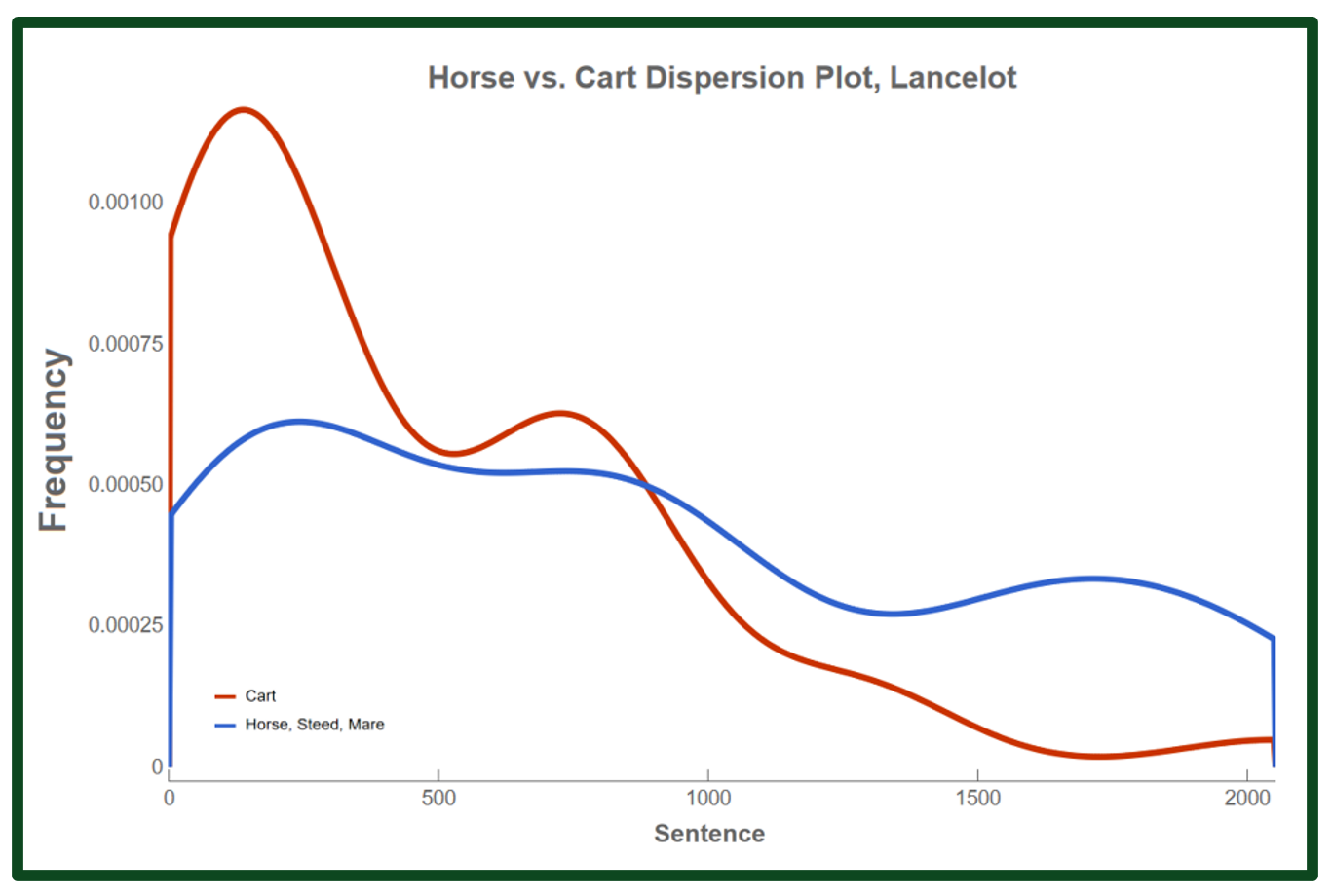
This action sets a course of emasculation that prevails throughout the story, as he is committed to relying on the will of a ‘low-born dwarf.’14
“Lancelot has, as it were, become emasculated… commitment to love has caused the emasculation.“15
The following images show comparisons between words associated with horse, words associated with carts, prevalence of ‘strong‘ words, prevalence of ‘weak‘ words. An interpretation for each images is included below.
Masculine vs. Emasculating Words, Lancelot
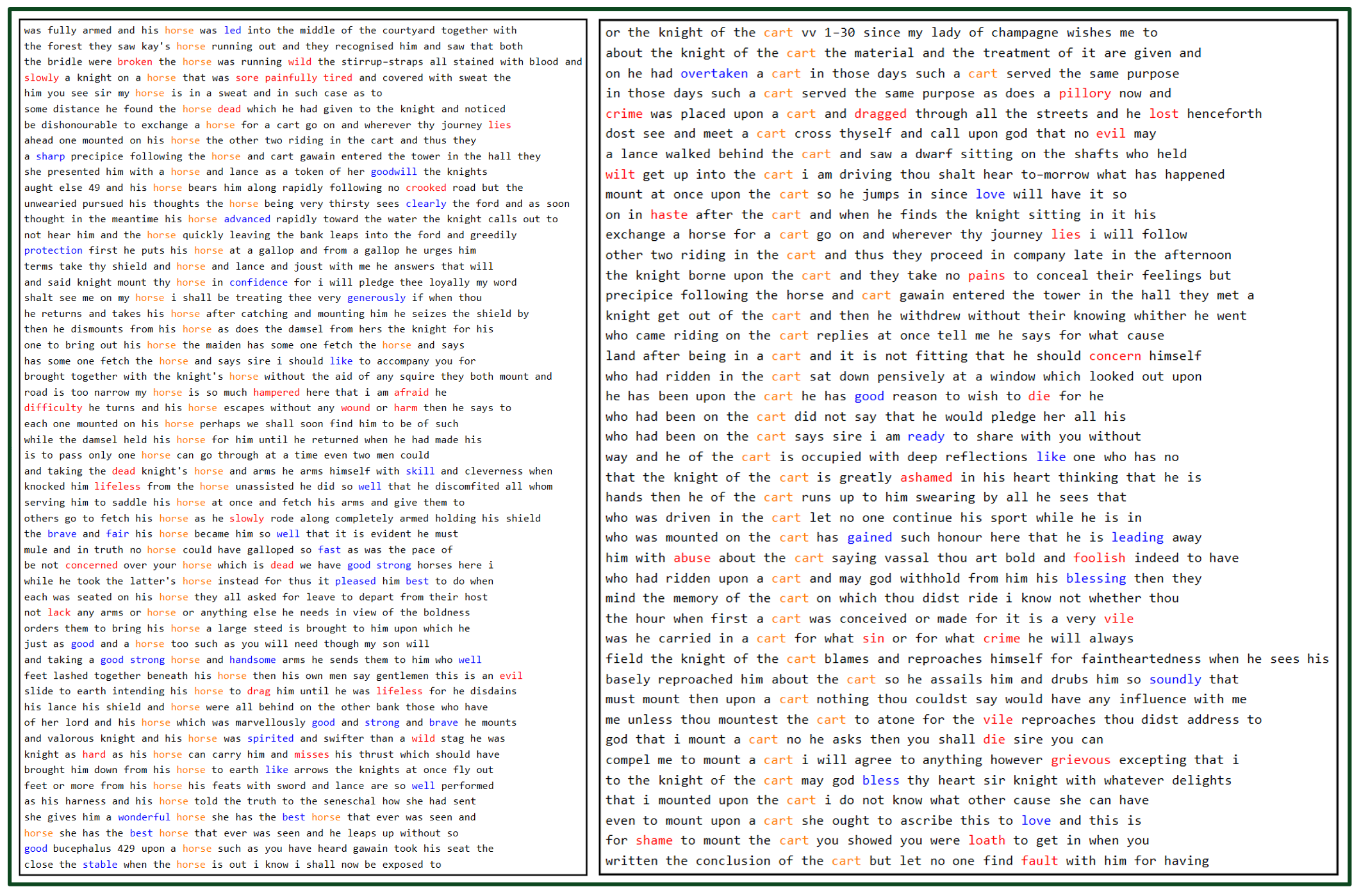
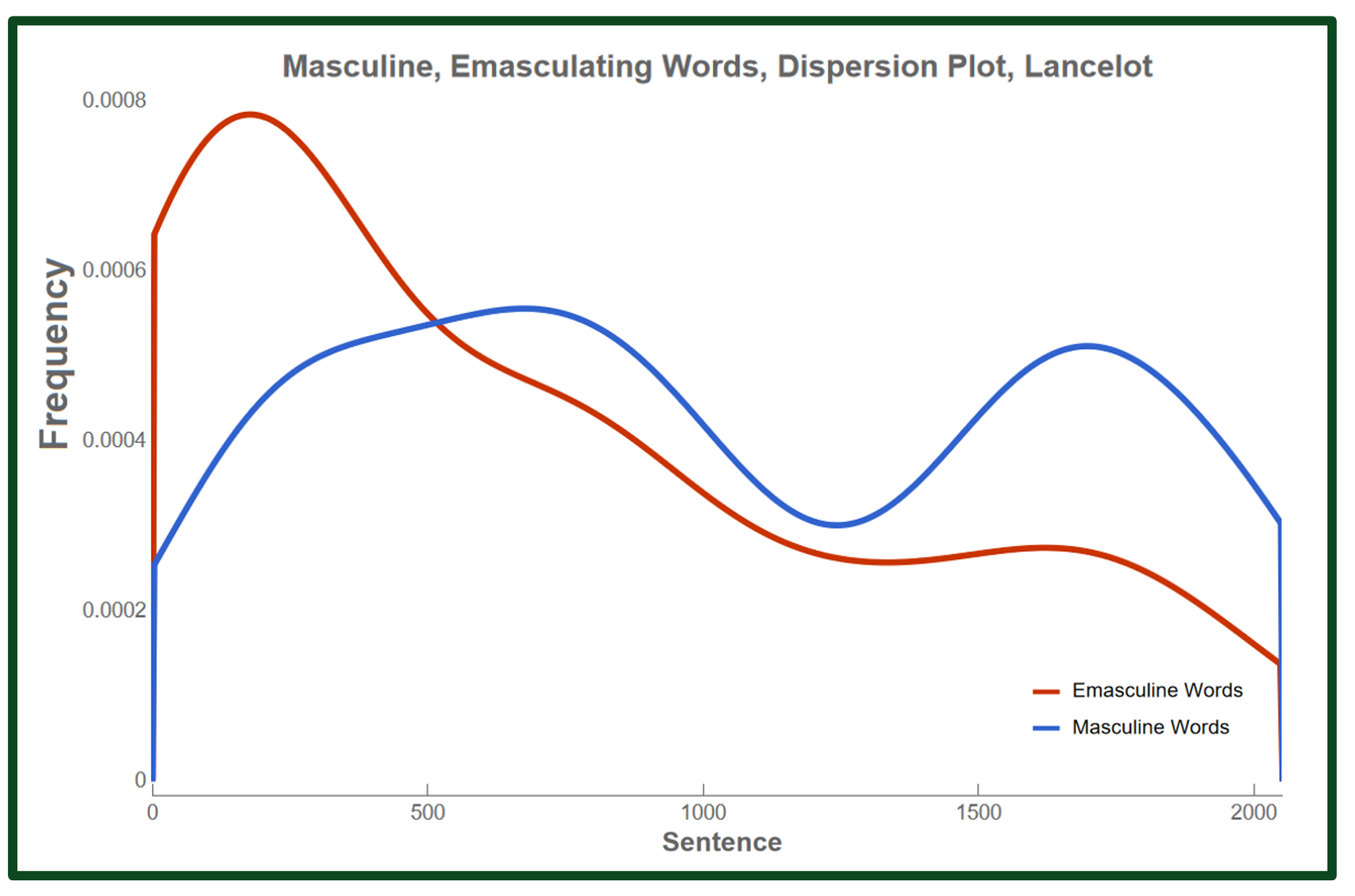
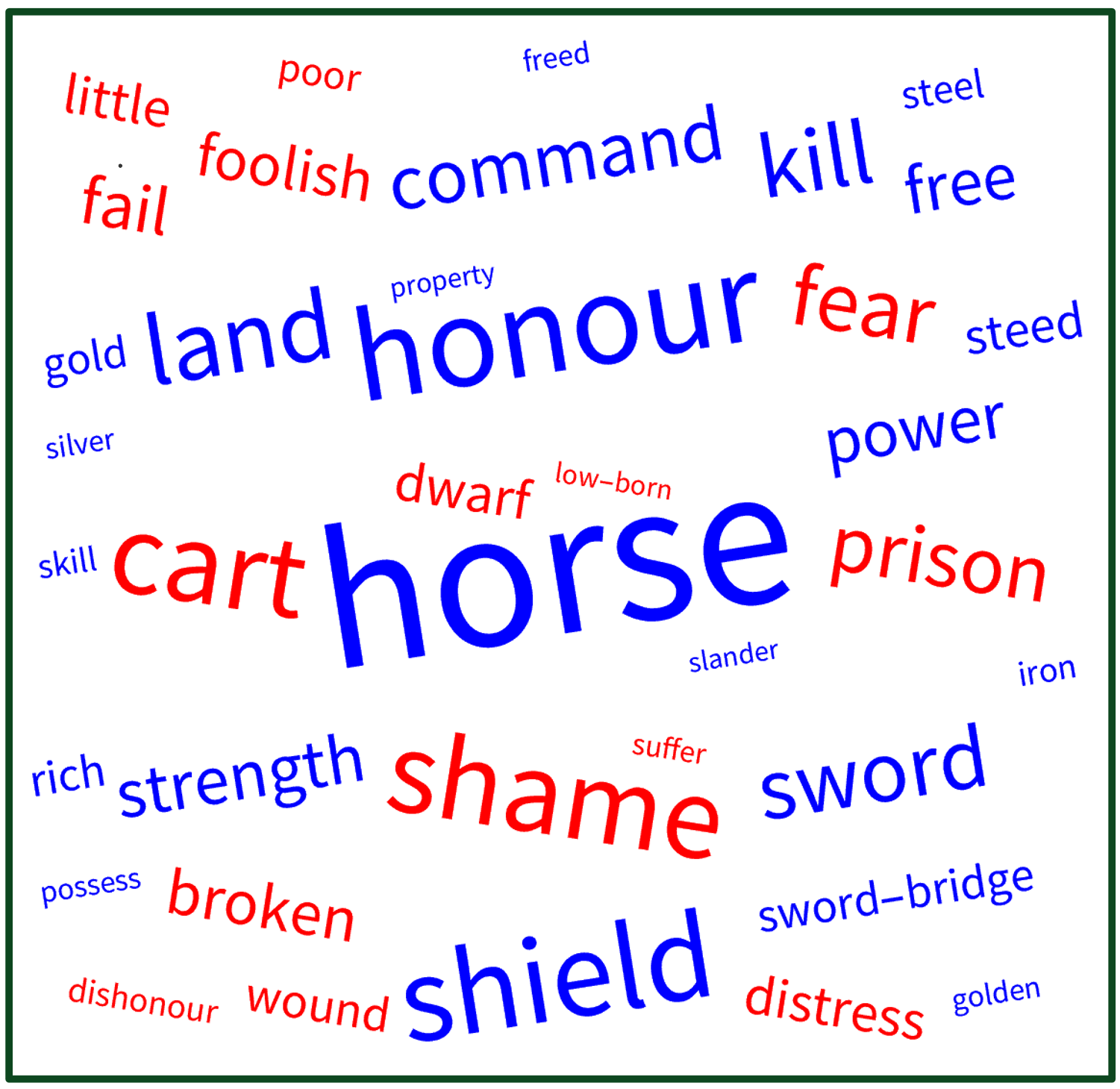
Image #1:
We check to see the connotations associated with the words depicting Lancelot’s type of transportation. In general, more positive words (depicted in blue) are associated with the horse. Connotations associated with the cart, however, appear to be worse, as shown by the larger prevalence of negative connotation words. The cart is emasculating for Lancelot as a knight.
Image #2:
The knight/horse dichotomy for strength vs. weakness is not the only type of textual analysis we can use, so we also run a similar smooth dispersion plot analysis with words we consider to be strong or weak. When Lancelot is held prisoner, far fewer masculine words are present, indicated by the min-dip around sentence 1200.
Image #3:
A WordCloud for added words is shown. More frequently occurring words are shown largest. Masculine words in blue and emasculating words in red.
Our findings demonstrate that Lancelot as a character is initially set up to be the masculine ideal, yet he is emasculated within the narrative. It is not just in the dwarf’s cart where Lancelot is emasculated but also in later sequences. Lancelot is imprisoned for a whole year in a castle.16 Numerous figures belittle him because of having entered the cart. At Guinevere’s behest, he nearly purposefully loses a tournament competing against other knights because she asks him to prove his love.17 This last example is particularly illustrative of the effect of Lancelot’s unyielding desire for the queen. He blindly follows her whims and thus the whims of his love even when it would mean humiliation and losing a contest of which he should rightfully be the winner. These examples give credence to the historiography. Fowler described how scholarship previous to him was biased against The Knight of the Cart because it was commissioned at the Lady of Champagne’s bequest. It has been written off as merely fantasies of a courtly lady. Lancelot’s journey and fervent love for the queen can be interpreted this way, but our sentiment analysis has shown that the narrative is not just treating Lancelot as an exemplum. Lancelot is a masculine knight and has excellent skill in knightly arenas; however, the story would not emasculate him and poke fun at him if it was not also a cautionary tale. Fowler reads Lancelot as a contradictory and satirical figure. Twelfth-century court audiences were familiar with the ideas of courtly love but regarded Lancelot’s extreme devotion as silly and laughable. The passage where Lancelot treasures a single strand of Guinevere’s hair and appraises it as more valuable than “all of the gold of Arabia” speaks to this reality.18 Thus we can interpret Lancelot not entirely as an aspirational masculine individual. Knights, noblemen, and lords familiar with this fable would have aspired to be as skilled as Lancelot with their swords but would have taken heed of the destructive nature of his all-consuming passion for the queen.
Concluding Remarks
In The Song of Roland, we argue that Roland fulfills the mantle and expectations of an epic hero; he is headstrong, loyal, and meets his station in society. We also believe that we have outlined via computational methods how he is more critical narratively than King Charlemagne, which is not an immediately obvious statement until one views the dispersion plots. It is interesting to note that Charlemagne does have more overall connections, but he is of lesser importance. His links reflect a King’s many interactions, whereas Roland’s indicate deeper bonds and his role as a warrior. Future research could involve analyzing whether Balegeant, Marsile, or Ganelon is the most prominent antagonist within the narrative. Perhaps analyzing interactions between these characters and labeling them as hostile interactions and then matching these interactions to the more important characters in the narrative would be a valuable avenue of computational research. In Egil’s Saga, we found that masculinity and wealth were inseparable. We also discovered Egil’s headstrongness was similar to Roland’s, which was exciting but not all that surprising. We mainly focused on concordances and modified sentiment curves to prove that wealth was tied to men’s status and masculinity. We also discovered that appearance was a powerful indicator of different character traits of men in the sagas. A future research topic could be comparing Egil’s Saga treatment of masculinity with other sagas. Feuds and violence are treated more delicately and with greater apprehension in other sagas. Additionally, wealth is also tied up with solving feuding to a greater extent in these other sagas. Using concordances concerning wealth in other sagas could shed light on how wealth functioned across all of nordic society and not just as a vehicle or signifier of masculinity. Finally, in our treatment of The Knight of the Cart, we discovered that Lancelot was not the ideal knight we believed him to be. Chretien sets him up as a deeply conflicted figure. He has all of the prowess and skills of the best knight, but his treasonous love of Guinevere sabotages him and prevents him from being a true example of romantic masculinity. Our findings are in agreement with the historiography. However, they also link the two different ideas of Lancelot as a cautionary and satirical figure and an emasculated one. No one has used concordances or sentiment curves to map out Lancelot’s masculinity or lack thereof. Perhaps looking forward, our methods focusing on masculinity could be applied to Chretien’s other works to compare how he treats other supposedly heroic figures.

Footnotes:
1 Glyn S. Burgess The Song of Roland (London, England: Penguin Books, 1990), Verse 45.
2 Burgess, The Song of Roland, 14.
3 Burgess, The Song of Roland, 104.
4 Burgess, The Song of Roland, 104.
5 Snorri Sturluson, Hermann Pálsson, and Paul Edwards. Egil’s Saga. (Harmondsworth: Penguin, 1976), Chapter 40.
6 Sturluson, Egil’s Saga 75.
7 Sturluson, Egil’s Saga 53.
8 Sturluson, Egil’s Saga 55.
9 Sturluson, Egil’s Saga 81.
10 Sturluson, Egil’s Saga 48.
11 Sturluson, Egil’s Saga 22.
12 Chrétien, William W Kibler, William W Kibler, Carleton W Carroll, and Carleton W Carroll. Arthurian Romances. (London, England: Penguin Books, 1991), Verses 247-398.
13 Edward I Condren “The Paradox of Chretien’s Lancelot” in MLN, Vol. 85, No. 4, (1970), 445.
14 Chrétien, Arthurian Romances, 247-398.
15 Condren “Chretien’s Lancelot”, 445.
16 Chrétien, Arthurian Romances, 5007-5198.
17 Chrétien, Arthurian Romances, 5641-6104.
18 Chrétien, Arthurian Romances, 1369-1552.

Works Cited
Burgess, Glyn S. The Song of Roland. Penguin Classics. London, England: Penguin Books, 1990.
Chrétien, William W Kibler, William W Kibler, Carleton W Carroll, and Carleton W Carroll. Arthurian Romances. Penguin Classics. London, England: Penguin Books, 1991.
Classen, Albrecht. “The Role of Wealth and Money in Medieval and Late-Medieval German Literature.” Neuphilologische Mitteilungen 101, no. 3 (2000): 415–28.
Condren, Edward I, ‘The Paradox of Chrétien’s Lancelot’, MLN, Vol. 85, No. 4, (May, 1970)
Fowler, David C. “Love in Chrétien’s “Lancelot”.” Romanic Review 63, no. 1 (Feb 01, 1972): 5.
Scala, Elizabeth. “Disarming Lancelot.” Studies in Philology 99, no. 4 (2002): 380–403.
Snorri Sturluson, Hermann Pálsson, and Paul Edwards. Egil’s Saga. The Penguin Classics. Harmondsworth: Penguin, 1976.
Walters, Lori, ed. Lancelot and Guinevere: A Casebook. Arthurian Characters and Themes, Vol. 4. London: Routledge, 2015.
Wills, Tarrin. “Physiology and Behavior in the Sagas.” Viking and Medieval Scandinavia 8 (2012): 279–97.
