The Medieval Fashion Week: What Does an Attire tell us About a Twelfth Century Society
Authors: Hailey, Giacomo, Emily
May 8, 2022
A knight in shining armor coming to the rescue is not an abnormal idea for those in the middle ages. In fact, knights in shining armor are the protagonists of most medieval literature, be it an epic like The Song of Roland or a romance such as Erec and Enide written by Chretien de Troyes. Chivalry, shame, courage, and gender dynamics are just a few of the themes within these texts that have been analyzed by many authors. No matter the theme, attire makes its way into many contexts and this paper is interested in addressing what attire, in medieval literature, informs about courtly roles in Medieval Europe. However, in the quest to determine what attire reveals about courtly roles, we analyzed many secondary sources and found that there are numerous arguments for the purpose of attire in medieval literature. Utilizing The Song of Roland and Erec and Enide, we determine our own ideas on the role of attire in medieval texts. We make out that the purpose of attire is to provide insights into courtly life during the middle ages such as the hierarchical positions in society, courtly ideals, confirming gender roles and how color implies the violent and religious component of knights.
Descriptions of knights are important in poems as attire is an asset to these characters. In The Song of Roland, Roland’s personality is described as brave and this is mostly in the context of a battle in which Roland has his trusty Durendal sword (Song of Roland, 64). This associates the ideal night as brave and accompanied with a reliable, consistent weapon. In Erec and Enide, Erec is the esteemed knight whose shield is a source of protection as well as a tool to kill. Erec chooses to fight with only his shield and lance, further showing the ways in which a great knight does not only act in fights but the accessories used (Chretien, 81). It is interesting to consider for the amount of times Roland and Erec are mentioned, how many times attire is associated with the mention of the character. Based on Erec in Context, Mathematica tools are able to be utilized to determine the number of times Erec appears and then if it is associated with an attire. Of the 298 times Erec is mentioned, 27 have attire references in the surrounding words (figure 1). In The Song of Roland based on Roland in Context, attire is referenced around Roland’s name 10 times (Figure 2). This is not as much as suspected and would most likely require more context, potentially 10 words in front and behind to really consider the extent attire is surrounding the mention of these characters. So, although it is not mentioned quite as much as we thought, it is still important to characters and important to those at court in the middle ages.
The attire attributed to a character completely reflects gender and position in society. For instance, when Enide is first introduced before marrying Erec she is described to reflect her poverty and virginity (Chretien, 56-57) but once she marries Erec, is dressed in an expensive tunic made of a rich green cloth tailored to fit her (Chretien, 57). Not only does clothing reflect the status and situation in society, but it makes and molds a courtly woman as it is the clothing which distinguishes between man and women (Burns, 282). Particularly with women, the clothing is meant to be an outside reflection of the fetishization and sexual attractivity of her flesh which is under the clothing (Burns, 282). Because clothing is the signal for the role one holds in society, for women what they wear can be seen as liberating or oppressive depending on the French literature (Burns, 283). In Erec and Enide, Chretien describes Enide’s beauty in detail, specifically the clothing she has on, in addition to explaining the “approving gaze” that the men at court give (Chretien, 263). Enide’s clothing and appearance contribute to the treatment she receives.
There is power in the attire that one dons. Within Medieval society, attire aids in confirming the wearer’s role in society, whether that is in regards to economic status, class status, or their honor. In a sense, for those who wear more traditionally acceptable clothing, they are signing a social contract deeming them as fitting societal standards. Medievalists have paid special attention to and documented those who dared to challenge the existing binary of gender roles. Within Erec and Enide, it is arguable that the attire worn is congruent with Medieval expectations of female and male roles. This is supported by the fact that the couple have regularly received comments regarding Enide’s beauty and emphasizing the importance of her being dressed in only the finest gown given her new status in the court. Furthermore, the poem features comments regarding Erec, a knightly figure, as handsome and bearing honorable armor. We can see these sentiments of Erec’s attire and knighthood fluctuate (figure 3).
Having established the role of attire and Medieval values and roles, Verbruggen had taken a position within the Women in Medieval Arms that values and roles can also be confirmed to individuals who had challenged the binary of gender expectations by performing in non-traditional roles and wearing clothes unique to those roles. Although there had been several characters of interest, the majority of the paper focused on the story of Jeanne D’Arc. Driven by the claim that she was sent by God to aid in the fight against the English, Jeanne D’Arc had a long journey to gain acceptance among the French as a soldier and leader. In addition to the in depth analysis of D’Arc’s journey and experiences as a woman who broke into a non-traditional role, especially one of such power leading violent and successful assaults, Verbruggen had also an acute interest in her choice of self presentation. Jeanne D’Arc understood the importance of choice in attire and had chosen to resist the traditionally feminine attire expected that women abide by, else they would be villainized and possibly ostracized (which during this period is dangerous for women to experience). Breaking further history, Jeanne D’arc notably wore more masculine attire and when needed, armor and swords. While once deemed unworthy of leading armies, D’Arc had proved her abilities time and time again. This new status granted her the opportunity to wear “Splendid white armor made to her measurements” (Verbruggen, 132) and possess a “Sword brought to her from the chapel of St. Catherine at Fierbois” (Verbruggen, 132). D’Arc embraced wearing “men’s clothing, forbidden to women,” (Verbruggen, 135) and how it “stirred up the rulers and the Christian people to wage war” (Verbruggen, 135). The change from the rejection of D’Arc to adoration of her, speaks a lot upon the shift in French society’s values. Therefore, the correlation present here and within Erec and Enide, between the acceptance or rejection of people in certain roles and changes in the quality of clothes, gives us a clear indication that attire is a reflection of the values of Medieval society.
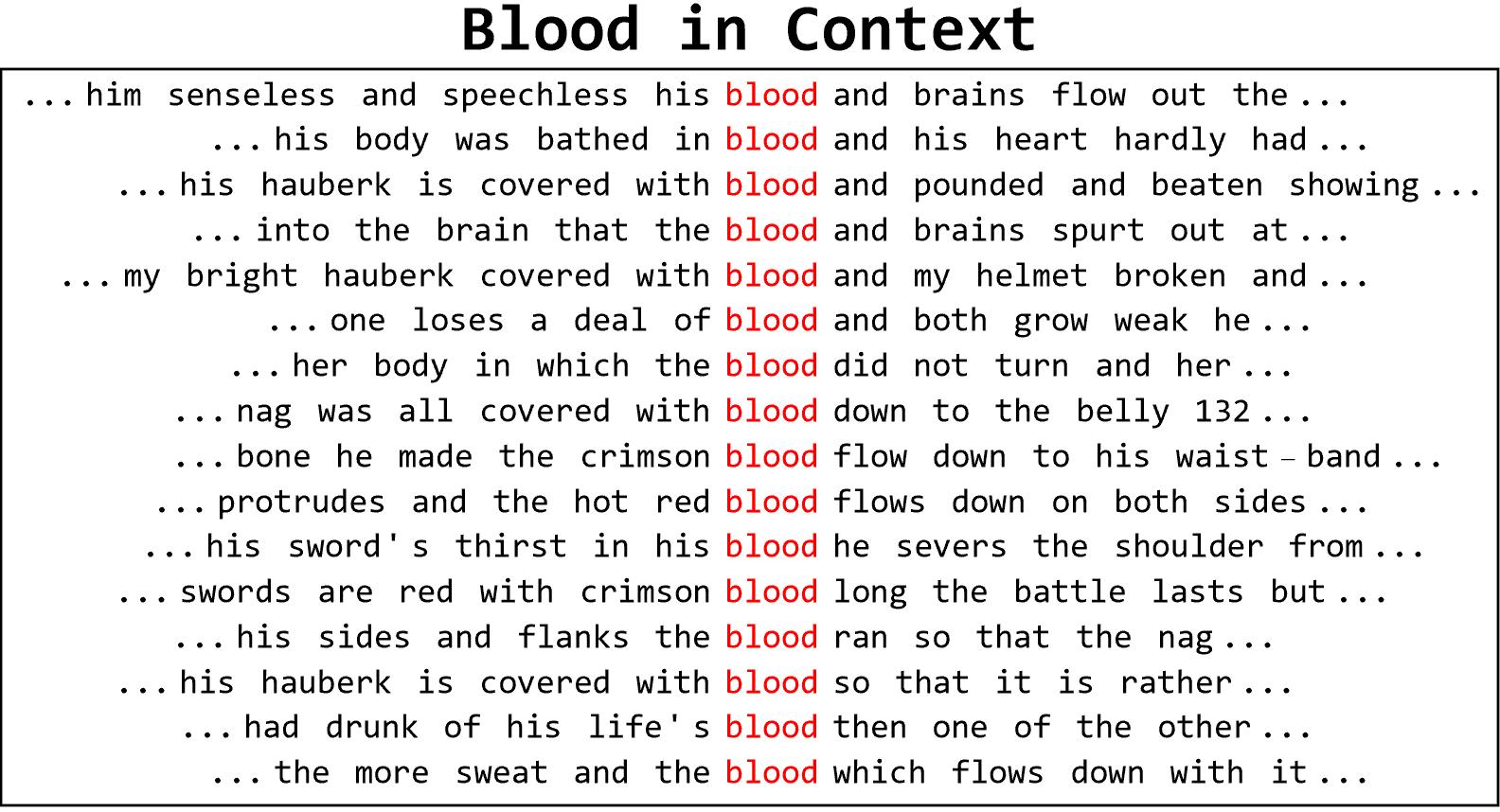
In relations with religion and culture, what an attire can tell is fascinating, the way people dress is a window to the audience and to the social world which is bound by cultural barriers, a custom that every hierarchical class and religion has to respect. Where religion is concerned, the attire can be divided into two distincts categories: the sacred and the secular. In the book called Ordene de chevalerie, written by an unknown author, the latter gives important insights on how a Christian knight attire conveys both an epic and a religious message. The protagonist of the poem has been captured by Saladin during a crusade and in order to be freed he has to pay an enormous amount of money or show how knights are formed in the Latin Christendom (Lieberman, 392). The author lists a set of actions, a sort of ritual, that every knight must follow. The first is to take a bath as a way to wash the body from sins that the knights have committed before. After that, the author gives us the first insight about the role of an attire for a knight, after having taken a bath the knight: “then donning a white robe for bodily cleanliness” (Lieberman, 392). The first purpose for the author is to show that wearing a white attire shows the audience a sense of connection between epic and religion that are now mixed together. As Southern argues in his book, the twelfth century has been a time of change, and this is the clear example of a connected line between religion and war (Southern, 219) . The author then moves onto describing what should be above a white robe: “a scarlet cloak for the blood to be shed defending the Church” (Lieberman, 392). This last quote supports the idea of Southern of a connection between epic and romance, the protagonist after he has purified his body, he must behave accordingly to what a knight is supposed to do, defend the honor by proving himself better than his enemies by killing them in battles. The color red is therefore a clear message of cruelty and blood that is not new in Medieval poems. In the Song of Roland, the color red, does not come up as many times as in the Ordene de chevalerie. Deepening into it, the color red is now referred to as blood, and is used 15 times (figure 4).
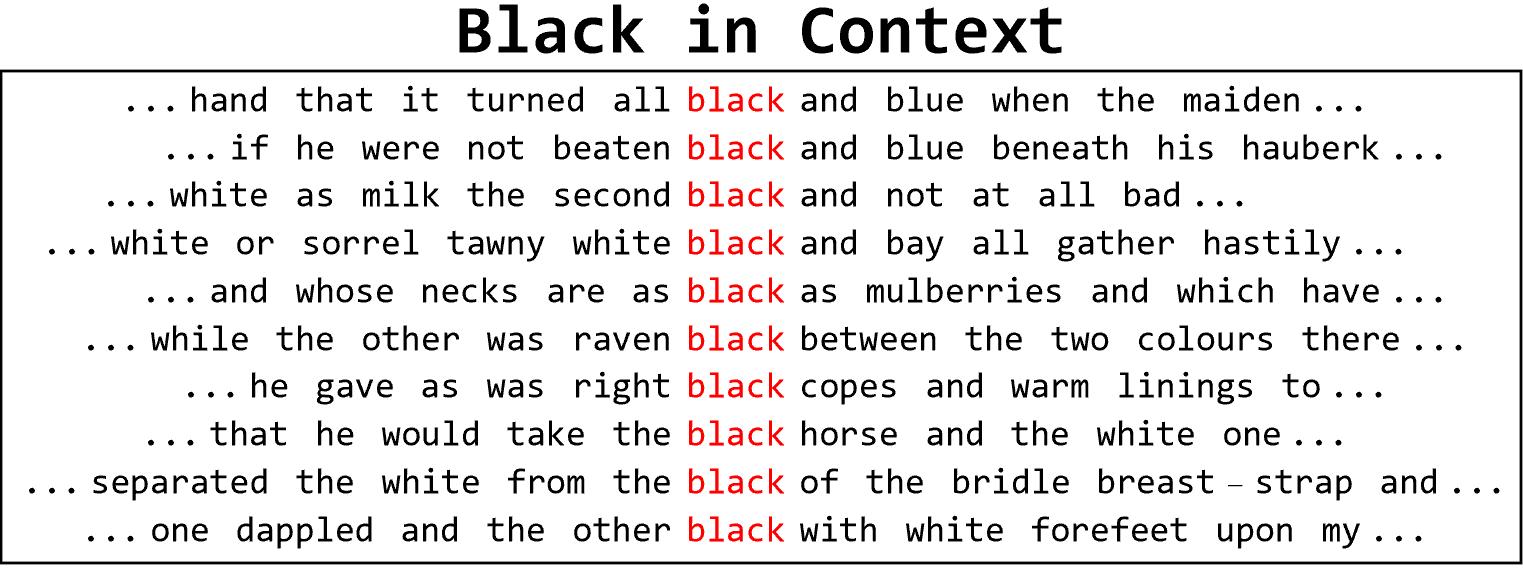
In contrast to Lieberman, in the Song or Roland the color shows up in the description of battles rather than clothes (Mathematica) and its relevance plays a crucial role in the vivid descriptions of the fights. Nevertheless the author of Song of Roland gives importance to the color white and in the description he draws comparisons and differences between Christians and Muslims. In a passage of Song of Roland the author states: “Roland sees the accursed people who are blacker than ink and have no white about them except their teeth”(Song of Roland, 144). Throughout the poem the use of white to describe the French and the color black to describe the Muslim army arises many times. The color white comes up 25, and as supported by the Mathematica analysis it is associated with the description of an attire of the French army as a symbol of purity as also supported by Lieberman (figure 5). In contrast to it, the Muslims, the people who were fighting against the French army, have been depicted with darker colors as a representation of the idea of these people as evil because non-Christian (figure 6).
In medieval texts, descriptions of events, battles, characters, and attires, most often are not a representation of reality, instead it is usual that the author’s imagination makes up descriptions of them (Wright, 193). Specifically, in the article written by Monica L. Wright, the latter argues that in Erec and Enide the purpose that an attire plays is to: “[provide] both structuring elements and thematic unity, as well as considerable reflections of twelfth-century French society (Wright, 193). In the first representation of Erec, Chretien makes a clear reference to the importance of an attire. The author writes: “[Erec] Mounted on a charger…dressed in a fur-lined mantle and a tunic of noble, patterned silk that had been made in Constantinople. He had put on silken stockings, very finely made and tailored; he was well set in his stirrups and was wearing golden spurs; he was unarmed except for his sword” (Chrétien, 38). From the beginning, Chrétien’s description of Erec, even though the audience knew nothing about him, the way he has been represented already tells that he was a knight, a valuable one, and that he was from a noble family. On the contrary, the first description that the author makes about Enide has a very different meaning. The first time Erec met Enide she has been described as: “[Enide] wore a white dress; she had no other clothes. And the dress was so old that it was worn through at the elbows. On the outside the clothing was poor, but the body beneath was lovely (Chrétien,42). Enide’s description tells the audience about a middle-low class impoverished by years of war. Her clothes are a representation of a misfortune that his father, a vavasour, is carrying over from years: “poverty ill-treats many men … I have spent so much time at war that I have lost all my land, and mortgaged and sold it.” (Chrétien, 43). In the Enide’s there is a reaffirmation of how an attire plays a crucial role in hierarchical position in society, as well as, as supported by Lieberman the importance of the color white to describe the purity of a body, a perfect match for such a valuable knight as Erec is.
Attire is used to idealize aspects of courtly life because the typical audience of medieval epics and romances were those at court. Erec and Enide was performed for the nobility and aristocratic public for both entertainment and political purposes (Chretien, 6, 37). Chretien had very close ties to Henry II of England and there are political motives behind the story, to help legitimize Henry II’s son, Geoffrey, claim to the throne of Brittany by underscoring the link between Geoffrey and Arthur (Chretien, 6, 118). If there are motivations to appeal to the desires of a Henry II, this would suggest that there are other ways in which Chretien desired to appeal to the audience, such as in the way people appear. Pleasing the audience is a primary goal of an author, and so providing such pleasure for the audience is possible in descriptions that not only can be imagined, but seem ideal to the audience (Szlinik, 87). Additionally, given that these poems were performed for those at court, there must be an accuracy to the descriptions of courtly attire as luxurious dress was a “hallmark of refined court life”, allowing readers now to picture what those people were wearing in addition reiterating the importance of appearance (Burns, 263). As for knights in courts and in romance’s in particular, they are typically wearing a shining, bright costume that is rarely dirty, unless bloody from battle, even though the lifestyle of a knight warrants blood, staines, and dirt (Hodges, 275). An example again of how the knight is idealized in these poems, potentially to appeal to the audience. However, the audience of these poems legitimizes the descriptions while also illuminating ideals in appearance and the attire of court at this time.
Conclusion
By digesting the insights of other secondary sources and combining those thoughts with our own analysis of The Song of Roland and Erec and Enide, it is clear that attire serves many purposes. Attire distinguishes one’s position in society, idealizes courtly life, confirms expectations of clothing for genders, and uses color to convey both the violent and religious components of a knight. As a result of our own research to weed out the true purpose of attire in medieval texts, we are able to better understand courtly life in the twelfth century. In fact, themes of chivalry, shame, courage, and gender roles can be examined to further depths by understanding the role of attire in these contexts. Furthermore, deeper understanding regarding the role of attire in the middle ages can help us understand its significance throughout history. Applying what we have learned here to the current era and tracking comparisons and differences overtime would be an interesting topic to explore.
Mathematica Text Analysis




Citations
Burns, E. J. “Speculum of the Courtly Lady: Women, Love, and Clothes.” Journal of Medieval and Early Modern Studies 29, no. 2 (Spring, 1999): 253-292.
Chrétien de Troyes. Arthurian Romances. Translated by William W. Kibler and Carleton W. Carroll. London: Penguin Books, 1991.
Hodges, Laura F.. “Costume rhetoric in the Knight’s portrait: Chaucer’s Every-Knight and his bismotered gypon.” Chaucer Review 29, no. 3 (1995): 274-302.
Lieberman, Max. “A new approach to the knighting ritual.” Speculum 90, no. 2 (2015): 391-423. Doi: 10.1017/S0038713415000032
Southern, Richard. The Making of the Middle Ages. New Haven: Yale University Press, 1953
Szkilnik, Michelle. “From sword to dress: the ideal knight in medieval French romance.” In Knight and Samurai: Actions and Images of Elite Warriors in Europe and East Asia, Edited by Deist, Rosemarie. Göppinger Arbeiten zur Germanistik; 707, 87-102. Göppingen: Kümmerle, 2003.
The Song of Roland. Translated by Glyn Burgess. London: Penguin Books, 1990.
Verbruggen, J.F.. “Women in Medieval Armies.” Journal of Medieval Military History 4 (2006): 119-136.
Wright, Monica L.. “The real unreal: Chrétien de Troyes’s fashioning of Erec and Enide.” In Refashioning Medieval and Early Modern Dress, Edited by Owen-Crocker, Gale R. and Clegg-Hyer, Maren. Medieval and Renaissance Clothing and Textiles, 193-209. Woodbridge, Suffolk: Boydell Press, 2019.
