Authors: Ethan Rodier and Noelle Cegielski
May 13th, 2022
The Importance of Main Characters in the Song of Roland and Erec and Enide
12th century society had a unique social structure which made for a unique historical period. With classes centered around royalty, religion, race, and gender among other factors, the perceptions and interactions these classes had with each other are quite compelling to study. This is especially true in the context of the literature at the time. Authors had to make their works appealing to the audience they were writing it for, and this meant using a social hierarchy in their stories fairly consistent with the one that they lived out in real life. Works would be used as entertainment sources and performed to the court, so members of the court were treated with the utmost respect in these stories. Considering social dynamics beyond the court, each story builds social networks that can be analyzed to see who the true main characters of the story are, which characters have the most interactions with others, and how connected the network is overall. The question to consider while reading this paper is how important are the central characters in 12th century literature to the overall social networks? To help answer this question, a network analysis will be conducted for the stories of Song of Roland and Erec and Enide. The importance of social networks in stories will be discussed, and then a comparison will be made between the two works in order to get an idea of the consistency of what networks were like during the 12th century. The conclusions that will be drawn as a result of this will display that central characters are crucial to the overall composition of social networks, and given their portrayals in their stories can make or break the structure of the networks that they are in.
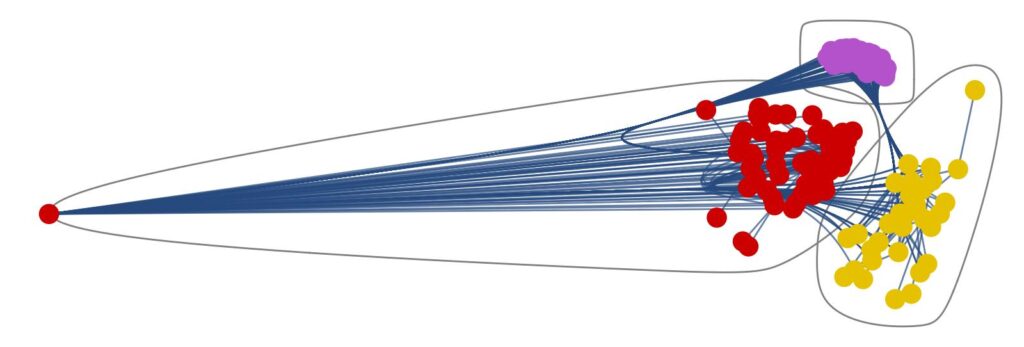
When going through a social network analysis, a useful graph to look at is the community graph. What this graph does is group together the social groups within the network of the story by context of which the characters are brought up, and the characters that they frequently have interactions with. It is imperative to analyze the social networks of historical literature in order to see if the realities portrayed within the stories were realistic at all, or if they were solely used for entertainment purposes.
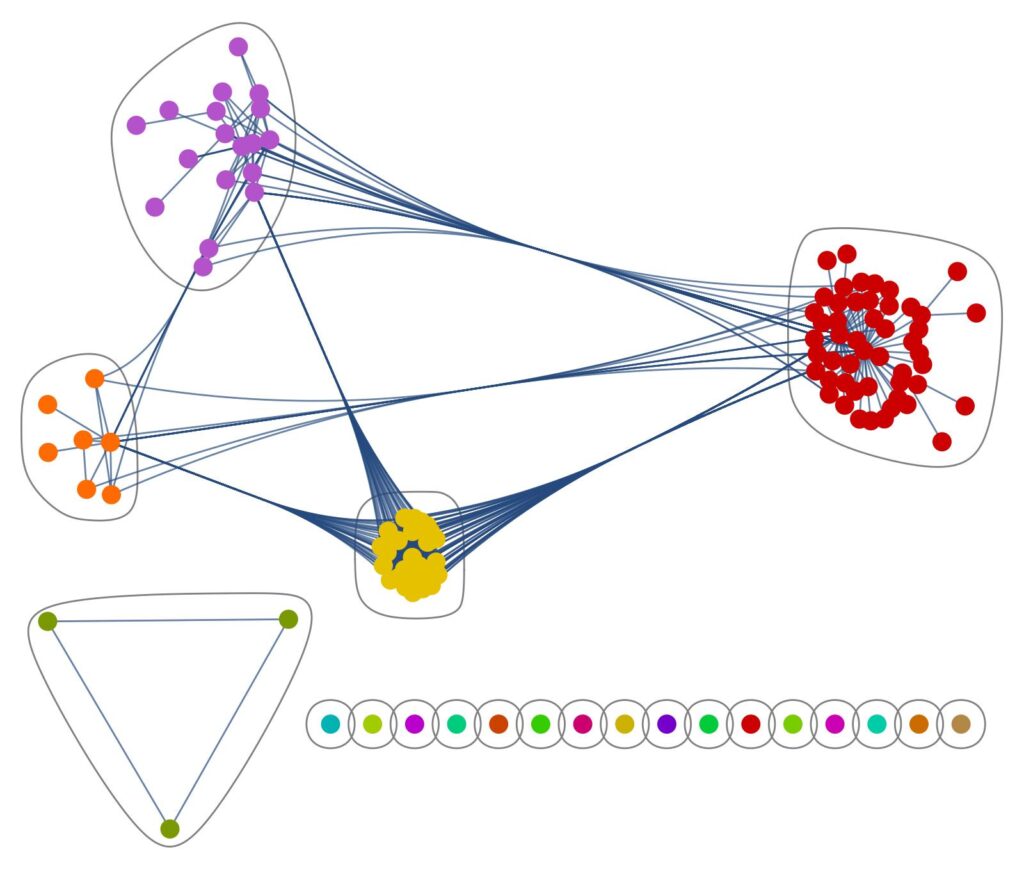
In Erec and Enide, as displayed below, it is evident from the community network graphs that a majority of the characters in the story had a relation to Erec, making him crucial to the plot of the story. It can also be seen that if Erec were to be hypothetically removed from the story, some characters would completely lose their significance and be left as single nodes separate from the rest of the social network. Without Erec to connect them in, these characters had zero interactions with any other characters in the story.
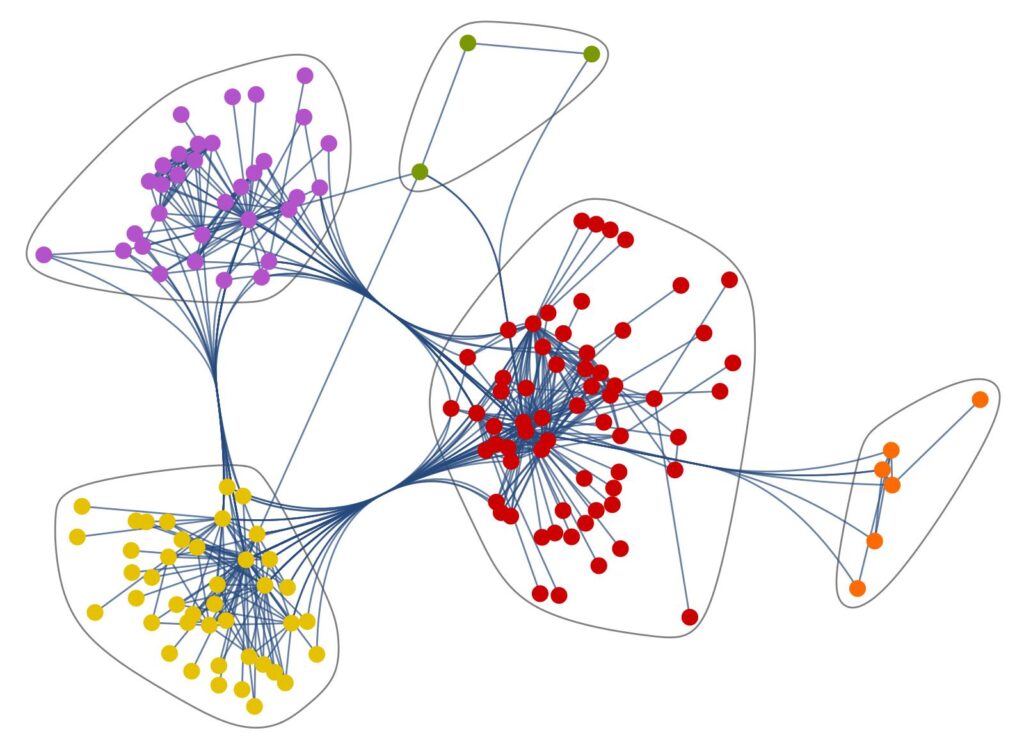
When looking at Song of Roland’s community graphs below, it can be seen that there is a little stronger connection between the social network as a whole, with Roland not being a node creating the overwhelming majority of connections present within the story. But with this said, like Erec, take Roland out of his story and the network becomes much more separated. Some nodes are forced into their own group on the chart separate from the rest, with their only connection from the story being through Roland.
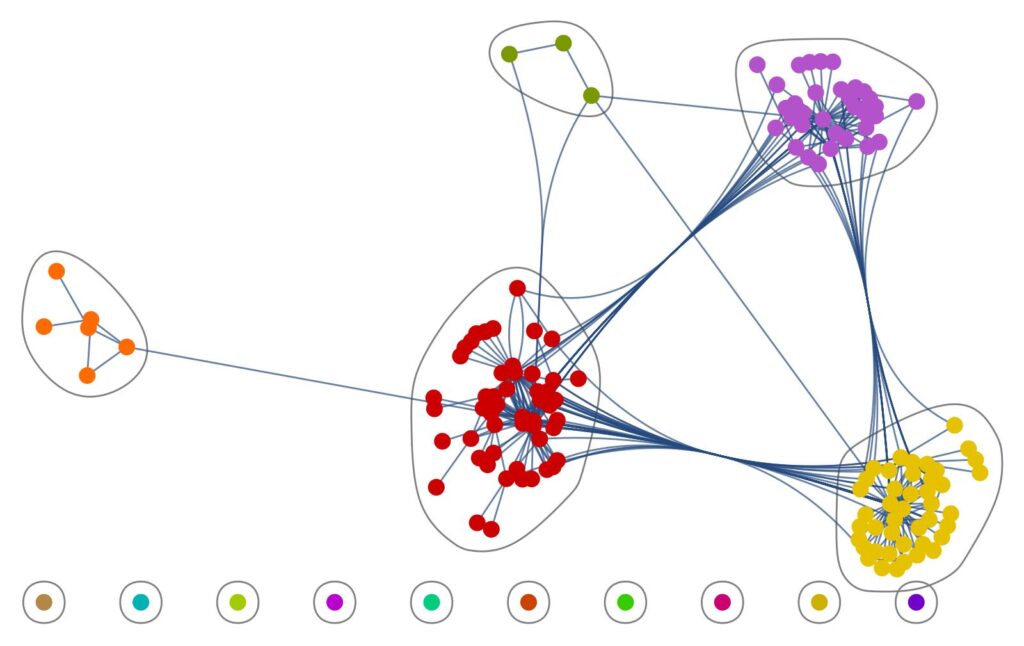
In these community network graphs, it becomes clear of how important the main character is to these stories. They play a very important role in creating many of the present connections in the story. Roland and Erec are the characters with nodes that have the most connections throughout the chart, especially to side characters that gave nothing to the story. When thinking about why this is the case, both Roland and Erec in their works were warriors, and fought many battles against characters trying to take them down. These characters were only introduced to serve the purpose of fighting the main character, and to end up going down in defeat. So these characters that become disconnected from the graph are those that fight Roland and Erec in battle and immediately fall to their death.
N[GraphAssortativity[roland]]
-0.34099
N[GraphAssortativity[ee]]
-0.459183
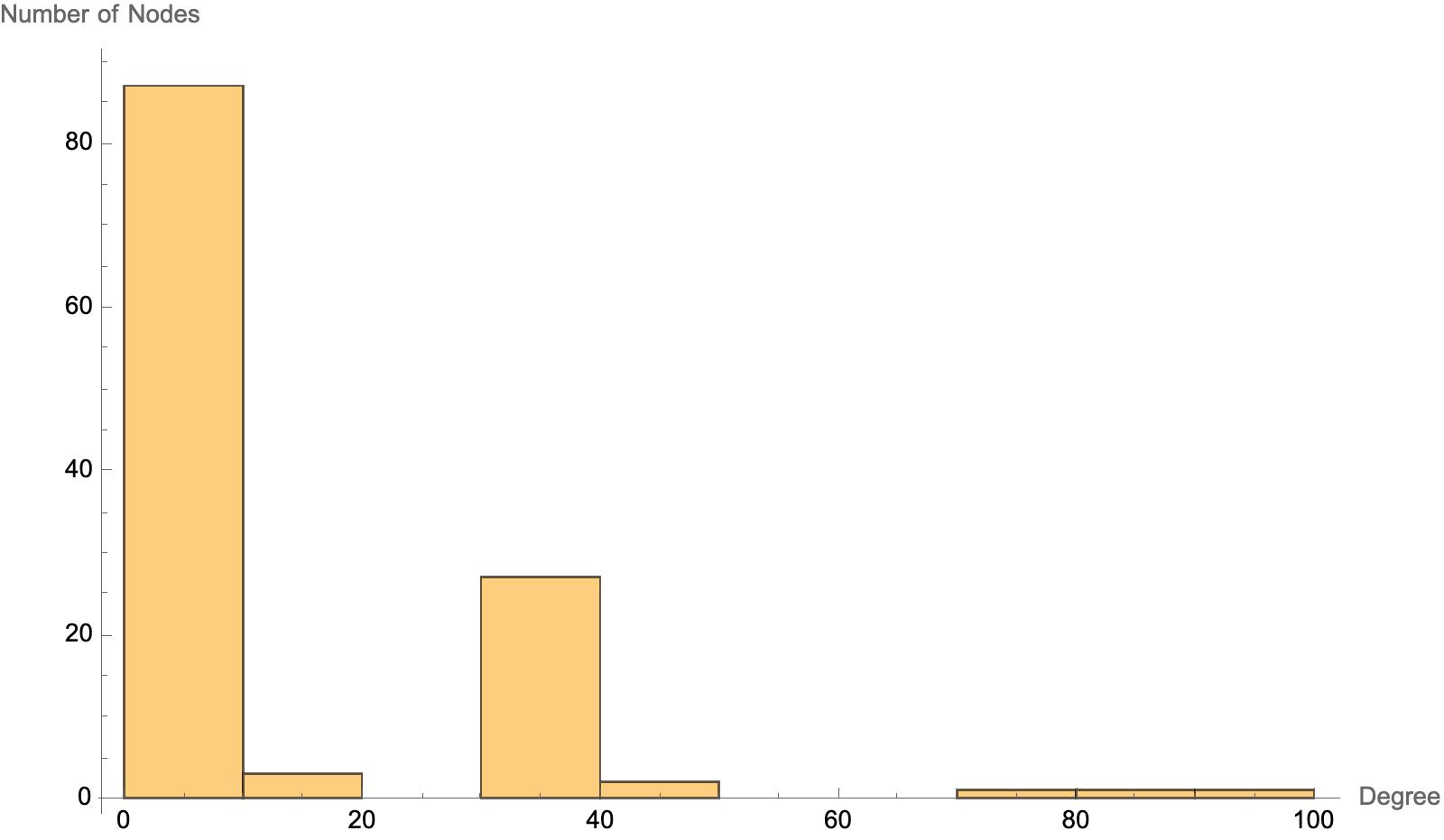
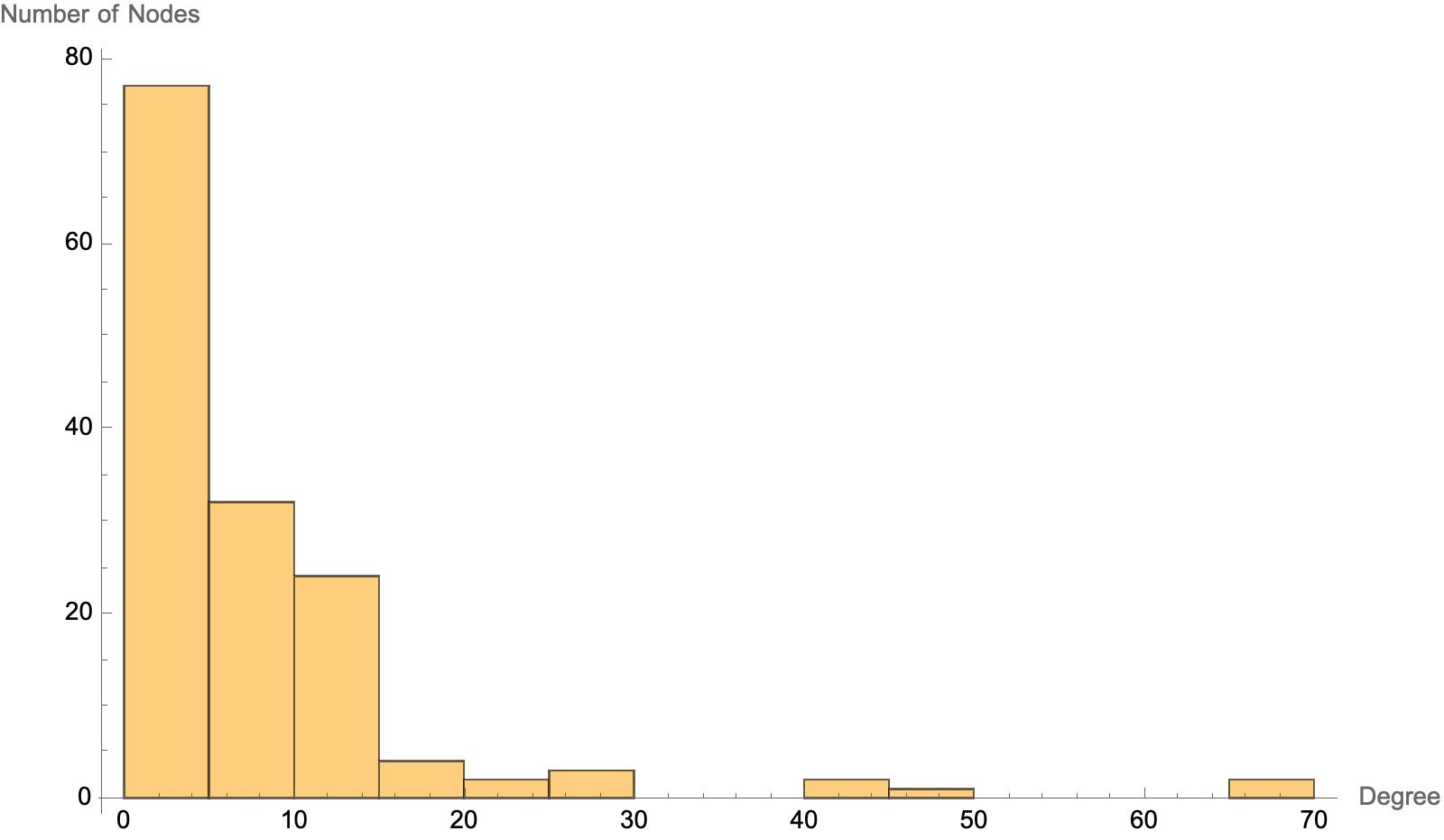
The community chart was chosen over the vertex graph for the main reason that it does not properly display the connections being made between characters. While it does do a proficient job of representing how tightly connected a network is, it cannot be seen how to break this down by groups, and which characters would be central to the stronger connections of the network. The graphs for Erec and Enide (first graph) and Song of Roland (second graph) are displayed to the side and can help give a picture to see how connected a social network is from an overall standpoint, but it cannot show how the networks are being connected. When seeing how the social networks were connected, it was also found to be useful to consider the dissociative measure for each story. What this measure shows is how assortative a social network is by making a number based on the connections in its respective work. If the number is positive, then that means the social network is well connected, and many of the characters have interactions with each other. If the number is negative, then the graph is dissociative, meaning that the social network isn’t very well connected. Calculations for this number were made for both Erec and Enide as well as Song of Roland, and as expected from the community charts, both numbers are in the negative. Erec and Enide had a dissociative measure of -0.459, while Song of Roland had a measure of -0.307. It is also expected that the measure for Erec and Enide is worse because of how important Erec is to the overall network in his story. Looking back at that community chart, he is the singular node that is the driving force behind the rest of the connections on the chart. While Roland is still very important to his story, he does not stand alone on his chart like Erec does. Where Song of Roland’s network differs is having more groups within the social network, which can help explain why they have such a weak dissociative measure.
What was very insightful to discover when making comparisons between Erec and Enide and Song of Roland is that there are many characteristic similarities across lines between the main characters of the story. Firstly, let’s look at Erec and Roland. Both are strong, fierce warriors who fear nothing or no one that stands in their way. They see themselves as leaders within their communities who tend to believe that whatever course of action they take is the right course of action. They both have very strong feelings of pride within themselves and oftentimes will ignore the people closest to them. In Both Roland and Erec’s minds, they have a role that Oliver and Enide play in their respective lives. Even though both Oliver and Enide offer strong wisdom from the reader’s perspective, neither Roland nor Erec takes the time to listen. Oliver and Enide both recognize the arrogance of their counterparts, but do not want to do any harm to them. Oliver explains this feeling by saing “there is a huge army of pagans, but might few of our franks” (Goldin 62). Enide says to Erec “I am afraid that you will be harmed” (Chrétien 72). In both these quotes, Oliver and Enide are calling to their wisdom instead of offering a direct warning. They both know that a warning would be completely ignored by Roland or Erec, as neither of them have any fear. In response to these words of wisdom from Oliver and Enide, Roland and Erec show off their shared sense of pride. Roland responds by talking about how “I should lose my good name” (Goldin 62), while Erec says to Enide “you really have too little esteem for me” (Chrétien 72). Both characters would rather die than bring shame upon their name. They both risk their lives on numerous occasions in battle to appear as the most valiant. Each battle becomes closer and closer with a meeting death, until both Roland and Erec both die despite wisdom from their closest characters. Luckily for Erec, Enide was around to rescue him and bring him back to life. In many of these situations of battle, Roland and Erec’s confidence is justified, with descriptions of how they simply are too skilled and too powerful for anyone who dares to be a challenger. But this confidence comes at the expense of fairly acknowledging their partners in the story. Oliver being a close compatriot to Roland, and Enide being Erec’s wife. Another way to consider these relationships is with the idea that both Roland and Erec and Oliver and Enide as below them, not as smart as them, or as powerful as them.
With the way the characters are described, it can be assumed that Roland and Erec are more powerful than their counterparts, and potentially smarter as well considering their upbringings. But like mentioned above, arrogance and pride gets in the way for them, and causes them to talk down to Oliver and Enide in situations where it isn’t justified. In the Song of Roland, a passage of interaction between Roland and Oliver shows how Oliver is treated by Roland, as phrases like “folly,” “lose my good name,” and “they are all condemned to death” (Goldin 62) are said towards him. The overall quote shows Roland’s disdain regarding advice Oliver gives him, as Roland believes he can take care of himself. On similar lines, in Erec & Enide, Erec tells Enide she is “disobeying my orders, and “doing what I forbade” (Chrétien 72). In their initial reactions, both Roland and Erec treat Oliver and Enide just like people to have around because they want to have them around and not because they expect them to do anything productive for them. What is interesting to see in both these stories is that after ignoring words of wisdom around them and getting too arrogant for their own good. This eventually leads to their demise, when the situation could have been avoided had they just chosen to listen. Erec realizes at his resurrection that he must change his ways and he becomes much more grateful for not just having Enide in his life, but what she can offer to improve his own. While Roland does begin to recognize the situation he is in and how brutal of a situation it is right before his death, he does not get the opportunity to redeem himself to any of his acquaintances who did not get the fair time of day.
When writing Erec and Enide, Chrétien knew that he had to stay true to the story that he was writing. It is an entertaining adventure story that is meant to entertain the audience, so instead of adding uninteresting details, he chose to inflate events to draw reactions and keep people engaged. The descriptions of the battles were captivating, and the emotions displayed from the characters kept the audience invested in the journeys of the characters. While Song of Roland is written like a poem, it has the same engaging style that does not mess around with unnecessary details. These are tales that are not the most realistic in how they unfold, but are misconstrued tales for entertainment purposes. An example of this is how peasants are written about. The stories written of peasants were never told out of interest to the audience, but rather they were satirical and used to motivate others to live a better life. This had led to them being incorrectly stereotyped throughout all of literature, and making it difficult to find accurate depictions of their lives. The lower classes were taken advantage of by the upper classes and used as pawns to serve functions in their lives instead of being treated like fellow human beings. In Erec and Enide, Enide comes from a peasant life that Erec takes her out of by marrying her, and it is described that it is not the strongest conditions she came from. Her upbringing is not dulled upon, nor would an audience to this story want it to be. The idea that Enide’s life became that much better after marriage is there to show how little peasant are thought out throughout literature, and why they are not very connected in their stories. The strongest points of the social networks in these stories are not where the lower class is present. When looking at the points of centrality on the social networks, the main characters and characters of royalty are the most central. Characters from lower classes are oftentimes only mentioned once or twice just to serve the story and nothing more. They are used as pawns of interaction to the main characters of the story to prove their importance, while showing that the lower class can be cast aside and treated as such.
To summarize, the social networks of 12th century literature tend to follow a common theme of the main characters being the focal points of interaction for the other characters in the story. Without their presence being consistent throughout their stories, the social networks would begin to capitulate without their connections. But with that said, the social networks that are present already do not have the strongest connections and often introduce characters that are only mentioned once, and are only there to keep the story going. It has to be questioned why both Erec and Enide and Song of Roland fail to have more integrated social networks. The main characters in each respective story play similar roles and act in very similar ways. They are perceived as such to be similar from a reader’s perspective, and this is seen throughout their interactions in the stories. What remains to be answered is why the social networks are left fairly disconnected in both Song of Roland and Erec and Enide. Could it be because they are stories of battle with characters that die quickly? Could it be that the authors did not care for the strength of the social networks? It is unfortunate the author’s minds cannot be dug into on that level, because it would make for some interesting conclusions about how they felt regarding the social networks in their stories.
Bibliography
Bailey, Anne E. “‘The Rich and the Poor, the Lesser and the Great.’” Cultural and Social History 11, no. 1 (2014): 9–29.
Dyer, Christopher. “Poverty and Its Relief in Late Medieval England.” Past & Present 216, no. 1 (2012): 41–78.
Goldin, Frederick. The Song of Roland. New York, NY: Norton, 1978.
Kosso, Cynthia, Anne Scott, and Phillipp Schofield. “Approaching Poverty in the Medieval Countryside.” Essay. In Poverty and Prosperity: In the Middle Ages and Renaissance, 95–112. Turnhout: Brepols, 2012.
McDonough, Susan. “Impoverished Mothers and Poor Widows: Negotiating Images of Poverty in Marseille’s Courts.” Journal of Medieval History 34, no. 1 (2008): 64–78.
Sweeney, Del, and Gerhard Jaritz. “The Material Culture of the Peasantry in the Late Middle Ages: ‘Image’ and ‘Reality.’” Essay. In Agriculture in the Middle Ages: Technology, Practice, and Representation, 163–88. Philadelphia, PA: University of Pennsylvania Press, 2016.Troyes, Chrétien de. Arthurian Romances. Vancouver, Canada: Access and Diversity, Crane Library, University of British Columbia, 2016.
